When the stock market takes a dive, what should you do?
By Randell Tiongson on August 25th, 2015
The Philippine Stock Market took a heavy beating yesterday, August 24, 2015 due to external factors. The fundamentals of the Philippine market has not changed but the bearish sentiments since March has made many investors jittery, to say the least. Last Friday’s major decline in the U.S. markets had a domino effect in the whole world, coupled by issues in China.
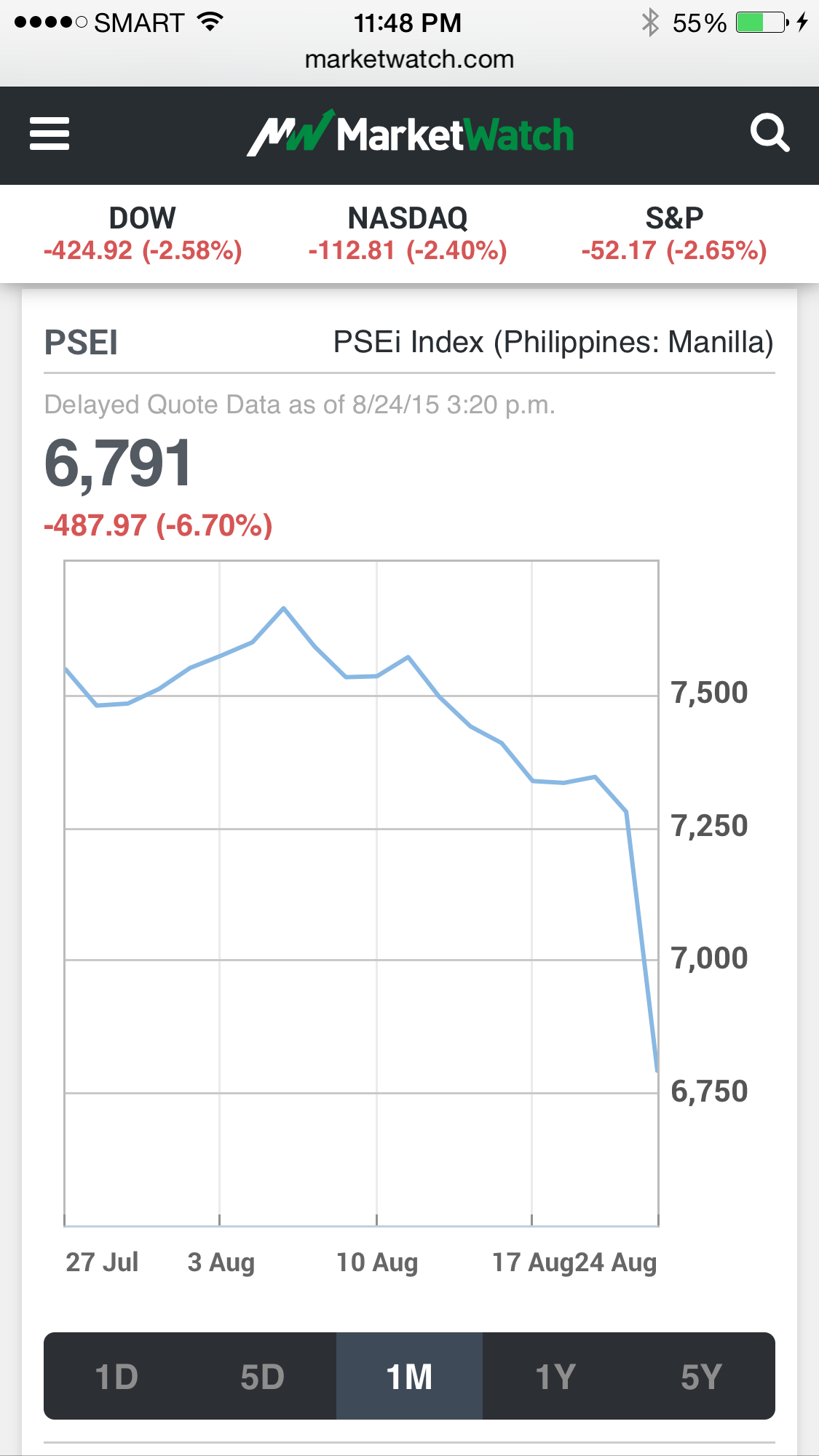
The result? The Philippine Stock Exchange Index (PSEi) drops by 487.97 points or a retraction of 6.70% to 6,791.01 in just one day.
I recently started a MoneyTalks Viber group and quite a number of people have been active in that group because of the stock market decline. It’s nice to see that there are a lot of people who are learning much from the interactions with the experts and with each other. If you want to be part of this very active group, send your Viber number to my assistant, michael@randelltiongson.com
While I will never downplay what has happened yesterday, I wish to remind many that the stock market is the way it was because that is it’s nature. It is said that the stock market can be overly optimistic or severely pessimistic and the later was what has been prevailing lately and especially yesterday. The stock market cannot defy gravity – what goes up most ultimately come down… but what goes down will also go up eventually. Despite the fears, I still believe that the stock market is a great way to grow your money but you must understand that it pays to think long-term when it comes to this kind of investing. This hold true whether you are buying individual stocks or investing through equity pooled funds (Mutual fund, UITF, VUL).
If you look at the how the stock market has behaved in one month, it really will scare you.
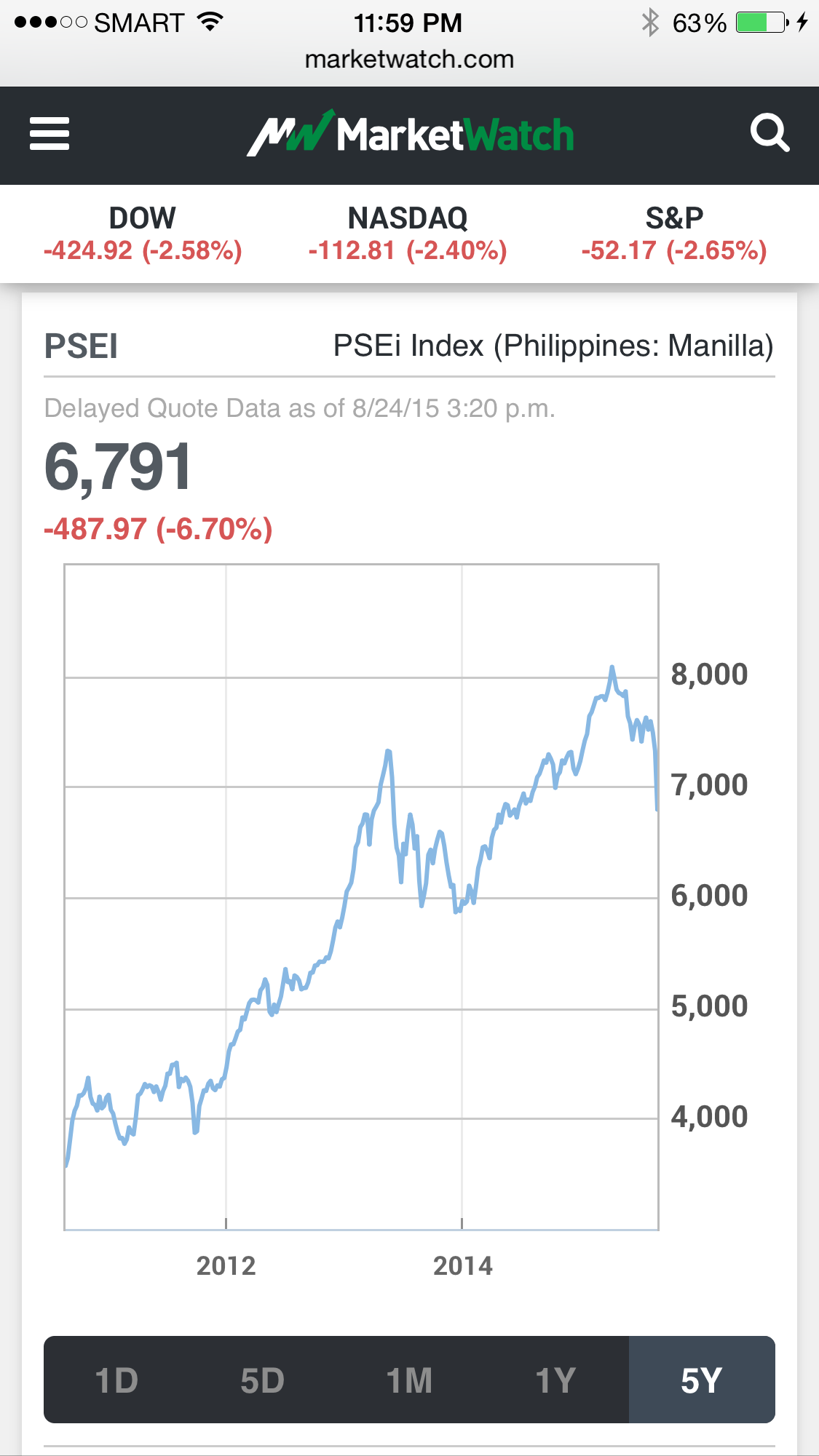
However, if you view the stock market from a long-term perspective, you will see a different picture.
I have asked my stock market expert friends of their advise to investors with regard to what’s happening in the market recently. You will find their advices insightful, helpful although they can have conflicting opinions.
“Today wasn’t a mere correction, it was more like major psychological and technical breakdown by the market. We advise investors not to catch a falling knife and to allow the market to signal an intermediate bottom first. Looking at the peso-dollar rate vs. this 7% one-day historical drop by the PSEi, we are not convinced that this is a structural exit away from PHL assets. Most likely we just had to adjust to regional peers which have come down much against us but had more modest corrections today.” – Tony Herbosa, Chairman of Philstocks and founder of Traders Apprentice Pilipinas (TAP)
Investors should understand that markets do not go up on a straight line and market declines happen. But it is during these drops when better opportunities are presented. For as long as you do not lose sight of the big picture of why you invest, there is nothing to worry about and continue with your investing journey to be financial free. Investing during these times is not just for the brave– it is for everyone. – Marvin Fausto, President of IFE Management Advisers Inc. & former Chief Investment Officer of BDO Universal Bank
While the severe drop in global stocks show critical issues and concerns on valuation, it is the pervasive negative sentiment that makes things worse. Times like these represent opportunities to take positions in companies that present good value, more so given the lower prices. The important thing to consider is one’s investment horizon, and staying power is key amidst the volatility. – Rex Mendoza, President of Rampver Financials and former CEO of Philamlife
Everyone should treat this market situation as like a major earthquake happening. A strong earthquake will have repercussions that take time. Those who are inside should not insist on going out in panic. Those outside should not go in. There will be aftershocks. Those inside should treat their stocks for the long term. Let the dusts settle before making any decision. –Dr. Alvin Ang, PhD, economist of Ateneo de Manila
The drop is an effect of price movement due to what’s happening globally. If you look at it, the rest of Asia and most of the developed world is down. When you look at the fundamentals of our country I don’t think locally there’s anything compelling that should be a cause of alarm. However, given that we are trading and investing in stocks. There’s such a thing as expensive and a bear market. Our fundamentals are good but we are still expensive which would cause buyers to want to wait out until we become cheaper. Our fundamentals are good but we have been in a downtrend since April and will continue to do so until proven otherwise. My suggestion is for each investor to follow their buy/sell plan. It would be great though if they could wait to see until selling subsides and forms a support before they buy. It’s great to buy cheaper but not when everyone else is selling. – Marvin Germo, stock market investing advocate and best-selling author.
Always invest according to your investment objective, time frame and they must be consistent with your risk tolerance. The stock market is not for the faint of heart but we should also not be afraid of stock investing. Learn as much as you can about stock investing and always invest according to the 3 factors I mentioned and don’t forget to diversify and you should be fine.
Supporting your family while saving for retirement
By Randell Tiongson on August 19th, 2015

Q: Hi Randell, I’m a regular employee in my late 20s. Having read your articles, I know it’s important to save for retirement early, but I also want to support my family (my parents and my younger siblings) financially. Is it possible to do both? –Inez, via Facebook
A: I’m glad that you’re looking out for your financial future while still being concerned about your family’s. In such a close-knit family culture like the one we have here in the Philippines, it’s natural to want to help out. But oftentimes, in their desire to help, a lot of people ignore their own financial health – and that’s not good. Here are a few steps to take if you want to support your family and save for your own future:
1. Put the mask on yourself first. If you’ve been on any flight (and you actually pay attention to the flight attendants’ pre-flight instructions), you know that when the oxygen masks drop, you’re supposed to put the mask on yourself first before you help put the mask on others. It’s the same for your finances; before you can help anyone else, help yourself first. Do you have an emergency fund? Is a portion of your salary going towards retirement already? Are you free from high-interest debt like credit cards? Then you can step up and contribute to your family. If not, take care of your own finances first.
2. Get insurance. Your contributions are vital to your family, so it makes sense to protect yourself with life insurance in case you’re unable to work. If you budget concerns and investments is not yet a priority, look at term life insurance plans, which provide coverage for serious illnesses and death for a certain period of time. You may also consider health insurance or HMOs if health is a major concern for you.
3. Know your family’s financial situation inside and out. Knowing your family’s financial capabilities will help you keep better control of your own finances. What do they need help with? How much do they need to pay whom? This may not be an easy conversation to have, but it’s important so that you don’t overextend yourself, and they don’t become reliant on you at the expense of your own future. When you know how much money they truly need, you can measure it against what you can provide as assistance, and you can provide for them while saving for yourself.
4. Set boundaries. Exactly what monetary help does your family need? How much will they need from you monthly, and for how long? What is the maximum you can provide for them? What are their financial goals? Setting these markers down will ensure that you stay on your financial track while still being able to help your family. When you help, make sure it is not encouraging the habit of dependency and entitlement.
5. Teach them good financial habits. Like the old saying about teaching a man how to fish, teaching your family good financial habits will be much more help to them in the long run that simply giving them money. Help them set a budget so they can meet their expenses, or assist them with finding money-making opportunities so that they can sustain themselves with minimal help from you. This way, they can have their own sources of income other than just you – freeing your finances up so you can save more, build your wealth, and be in a better position to help them out if more financial setbacks arise.
Discussing family finances is not the easiest thing to do, but it’s very important if you want to help your family while still helping yourself. Improve your finances and get yourself on solid ground before you commit your resources to helping out. It’s important to be there for your family, and by following the steps above, you can ensure a good future for yourself while getting your loved ones on better financial footing.
What does the bible say about these things?
We should honor our parents — “Honor your father and your mother, that your days may be long in the land that the LORD your God is giving you. (Exodus 20:12, ESV). It was further reinforced in Ephesians 6:2 —“Honor your father and mother” (this is the first commandment with a promise).
However, the bible is likewise clear about the obligations of a parent — Here for the third time I am ready to come to you. And I will not be a burden, for I seek not what is yours but you. For children are not obligated to save up for their parents, but parents for their children. (2 Corinthians 12:14, ESV).
Seek wisdom with these things… be in faith and be a good steward of your finances lest you your children may end up having the same burden as you have for your parents.
A good man leaves an inheritance to his children’s children, but the sinner’s wealth is laid up for the righteous. (Proverbs 13:22, ESV)
On-line life insurance
By Randell Tiongson on August 18th, 2015
 38 million Filipinos are now regular internet users, according to a report by the Internet and Mobile Marketing Association of the Philippines (IMMAP). With the increasing number of Filipinos online, it’s important that services are available online as where so people can avail of them anytime, anywhere, at their convenience.
Over the last few years, local companies have been making strides towards giving access to their services online, such as retailers, car insurance providers, banks, and others.
In light of the need to be online, AXA Philippines launched AXA iON or AXA Insurance Online, the country’s first online insurance store, last September. Their aim is to make insurance available to people aged 18 to 45 who may not have time or may be too intimidated to go into a brick-and-mortar insurance office, or are out of the country and can’t apply otherwise, such as OFWs.
AXA iON offers four different plans, to present savvy online consumers with basic products for securing their financial futures: Savings Exentials, which is like a levelled-up savings account with a guaranteed payout; Academic Exentials, for saving up for your children’s education; Life Exentials, which pays out cash for up to 60 months in case of your death or terminal illness; and Health Exentials, which covers you for 35 critical conditions or illnesses.
Customers can pay their premiums via Visa or MasterCard credit cards, through an auto-charge facility.
The whole process is online, meaning anybody can apply from whatever device they’re using. Simply visit axaion.com.ph, fill out the online application form, and pay using your credit card. No need to submit any forms or talk to agents – although a representative will call you after your application to confirm the information you submitted.
If you’re still more comfortable talking to an agent, though, you can use the AXA iON platform as a starting point to explore the options available to you, and then you can go to an agent with more questions to help you choose the right insurance coverage.
This online application is also good for our OFWs, so that they can safeguard their earnings and provide for their family without having to fill out a million forms and wait very long for the process.
Hopefully, more providers follow this lead. When the application process for vital financial tools such as life insurance and health insurance becomes easier and more convenient, more people will be insured, and will be on their way towards financial freedom.
Your life is your greatest asset. Manage your risks by making sure you’re adequately insured.