How to increase your income
By Randell Tiongson on March 12th, 2019

INVEST IN YOURSELF
I believe the best way to improve your income is to first invest on your best performing asset—YOU! Improving yourself will be the best way for you to earn more. Have you ever honestly asked the question, “Am I investing in myself?”
When was the last time you read a good book? When I say “good book,” I am referring to good reference materials, and not those fictional stories of vampires in love or some fantasy magical school. I noticed that many Filipinos are not in the habit of reading, and I was one of them until my friends from church gave me books and encouraged me to read more. When I started reading books, I realized that I was getting better at my writing, my teaching, and was even becoming an interesting conversationalist. There were many new things I picked up that were directly or indirectly related to my profession. I did not limit my reading to finance materials. I started to read many books on leadership, marketing, investing, economics, business, and others. Of course, part of my daily reading is the Bible where I get much wisdom, especially for financial matters.
I try to read foreign and local books. Foreign writers whose books I love to read are Andy Stanley, John Maxwell, Dave Ramsey, Seth Godin, Larry Burkett, among others. I’ve also found some local books insightful such as the books of Marvin Germo, Dodong Cacanando, Rex Mendoza, Jayson Lo and Dennis Sy, among others,
I don’t limit myself to reading just books; I regularly follow columnists like Efren Cruz, Cito Beltran, Wilson Lee Flores, John Mangun, Henry Ong, etc. I also devour a lot of stuff from the internet, reading many blogs, vlogs, etc. I spend about 1 to 2 hours daily reading, researching, and studying materials. I even go through a lot of Twitter posts; picking up potential materials I can use and following the links.
Podcasts are also something I like listening to especially when I am travelling. I make it a point to periodically listen to the podcasts of Dave Ramsey and Ravi Zacharias.
I also converse frequently with a lot of people and my mentors. Coffee or lunch sessions with them have always been a huge learning opportunity for me. Most notable are my sessions with Rex Mendoza, Dodong Cacanando, Francis Kong and others. My sessions with peers have been great learning opportunities that truly helped me learn, apply, and teach.
I must confess that I still have a lot of unread materials, un-played podcasts, un-opened links, and un-served coffee that I need to work on but I will get to them sooner than later.
INVEST ON LEARNING
It is always a good idea to invest in learning. Many Filipinos are not big fans of trainings and seminars—a big mistake if you ask me. The more I learn from trainings and seminars, reading books, talking to great mentors, and reading columns, the more productive I get.
When I was a young insurance agent, I took a special certification program being offered in the industry. Many of my peers felt it was a waste of money and a waste of time. Instead of being encouraging, many actually discouraged me from spending my hard-earned money (which I didn’t have much of) on a seminar which they saw as useless. While the program was far from perfect, the learning I picked up was able to make me a better insurance agent and gave me a thirst to learn more. I saw myself becoming more confident and competent because of the learning. My investment definitely paid off because I was able to improve my revenue as a direct result of the program I took.
Years later, I became a manager of insurance agents in the company I used to represent. I stumbled upon an imported program for agency leaders but the enrollment cost was quite steep. If I remember it right, the cost was more than P50,000 to enroll in the program. Many of the agency managers in my industry were not investing in the program, and most of them cited cost and time as a reason. Being the learner that I am, I reviewed the program and knew I could benefit from it even if my peers thought otherwise. True enough, I became a better agency manager as a result and my income reflected a rise in multiples of what I paid for the training. I took many more programs and invested in dozens of seminars in a span of two decades—some of those carried a hefty price tag, like the conference I attended in Singapore once you factor in plane fare, hotel, and other incidentals on top of the pricey conference fee.
I have lost track of how much money I spent on my learning but it was all worth it. While there were a number of conferences or books that weren’t really as helpful as I wanted them to be, I’d say that I have learned much from them and it has contributed to who I am today. The returns are quite difficult to compute but it has really paid off in exponential ways. In fact, some of the programs I took I ended up teaching myself.
BE ENTERPRISING
Have you considered becoming an entrepreneur? Many people think that entrepreneurship is not for everyone, and I do agree. I subscribe to the belief that not everyone is cut out to be an entrepreneur. It is unfortunate whenever someone goes into business and ends up losing money. Here’s my big ‘however’… I think many of us think that those who can’t go into business are too overstated. I’d like to believe that more Filipinos can go into enterprise. My many runs with Go Negosyo and the Association of Filipino Franchisers (AFFI) made me realize that many of us have the potential to be in business and actually make it big. If we have an open mind, we can become an entrepreneur—with God’s grace, you just might make it.
I need to note, however, that we must go into business prepared and not blindly. Learn about the business you want to get into—read about it, research, talk to people, observe the market, prepare a written business plan, check on your finances and all that. There are many reference materials on being an entrepreneur—Go Negosyo has published many books that are easy to understand and yet detailed enough for you to start with. My friend Paulo Tibig also wrote a very helpful book entitled 10 Strategies of a Champion Entrepreneur, a highly recommendable book for those who want to venture into business.
Being entrepreneurial doesn’t mean you need to start a big corporation at once—try some basic buy and sell first or do some commission selling. I am sure there are many opportunities abound for those earnestly seeking. The stories of many successful entrepreneurs in the country are very encouraging because nearly all of them started very small and have very humble beginnings. Any form of additional income from being entrepreneurial will do wonders to augment your cash flow, and that’s when the fun begins.
I once heard Francis Kong say in a seminar, “If you can’t be an entrepreneur, have an entrepreneurial mindset.” Wise words to live by indeed.
Do not let your situation hinder you from improving your income, I know from experience that there are more ways to earn more if you are dedicated and disciplined enough.
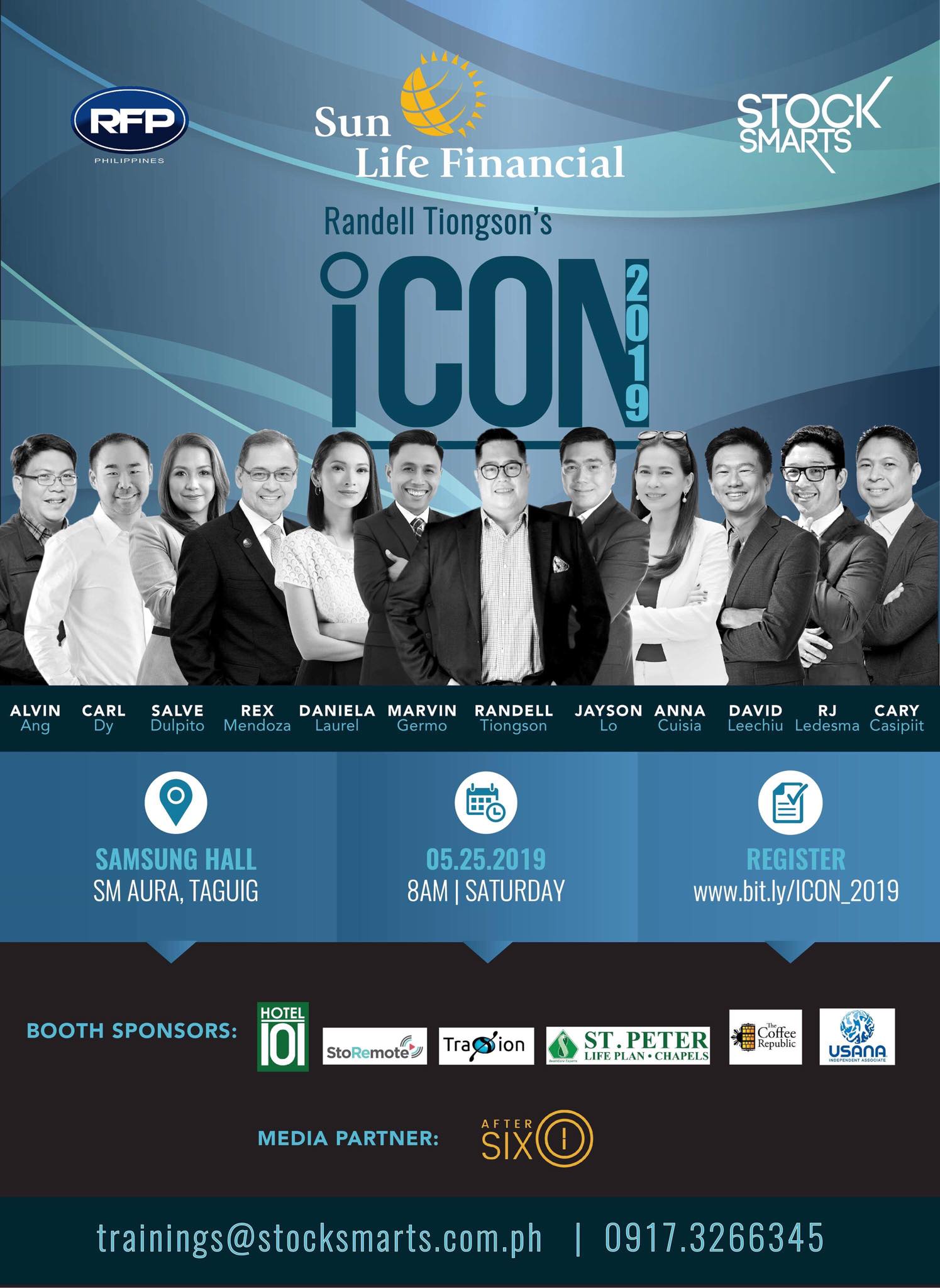
Join me and the Philippines’ leading finance and business experts at the country’s most empowering investment conference; #iCON2019
Details and registration via www.bit.ly/ICON_2019
Why I do what I do
By Randell Tiongson on March 2nd, 2019

Towards the end of 2008 and in the midst of the worst financial crisis in recent history, I decided to quit my job and leave the comforts of a steady corporate job and a good paying one at that. To do what? To do what I have been doing in the last 10 years or so — being an advocate of personal finance: speaking, writing, teaching, traveling, counselling and engaging anyone who needs to learn personal finance.
What I do is exciting but can also be exhausting. I speak about 150 times a year; I do back to back seminars that runs the whole day; I move from one place to another; travel a lot (and be away from my family); guests in so many multi-media platforms; write a lot (and I don’t like writing) and meet and speak to so many people. Why? I believe I need to do my part to make sure that Filipinos become financially empowered. Being financially empowered is very important to all of us and everyone of us should make this a top goal in our lives. We all have our reasons why we need to be financially empowered—we do it for our goals, we do it for our families, we do it for our communities, and so forth. I believe we all have noble reasons why we need to experience financial freedom and, more importantly, financial peace.
However, I would like to seek a deeper purpose on why we all need to be financially-abled and why we need to be blessed with financial empowerment. I believe that the true purpose of wealth goes beyond the comforts of life or a good future for our children. I strongly believe that we should become financially-abled because we need to be a channel of blessing for God to use to advance His kingdom.
We are not placed on earth for our own purposes. We need to constantly seek the Lord’s purpose for us and focus towards achieving such a purpose. Financial empowerment is not an end goal; it is merely a tool for a greater purpose. I believe that my true purpose goes beyond my own financial enablement—my true purpose is to worship God. Everything I do and everything I will do should be an act of worship. Remember, wealth and the ability to create wealth comes from God. It is not to achieve our own purposes, but to achieve His.
My personal experience has led me to embrace the truth that every financial decision (and all other decisions) I make is likewise a spiritual decision. When I gave my life to Jesus, I found my purpose and I found all the answers—financial and otherwise. Seek Him, and there you will find what true peace is all about. Yes, even financial peace.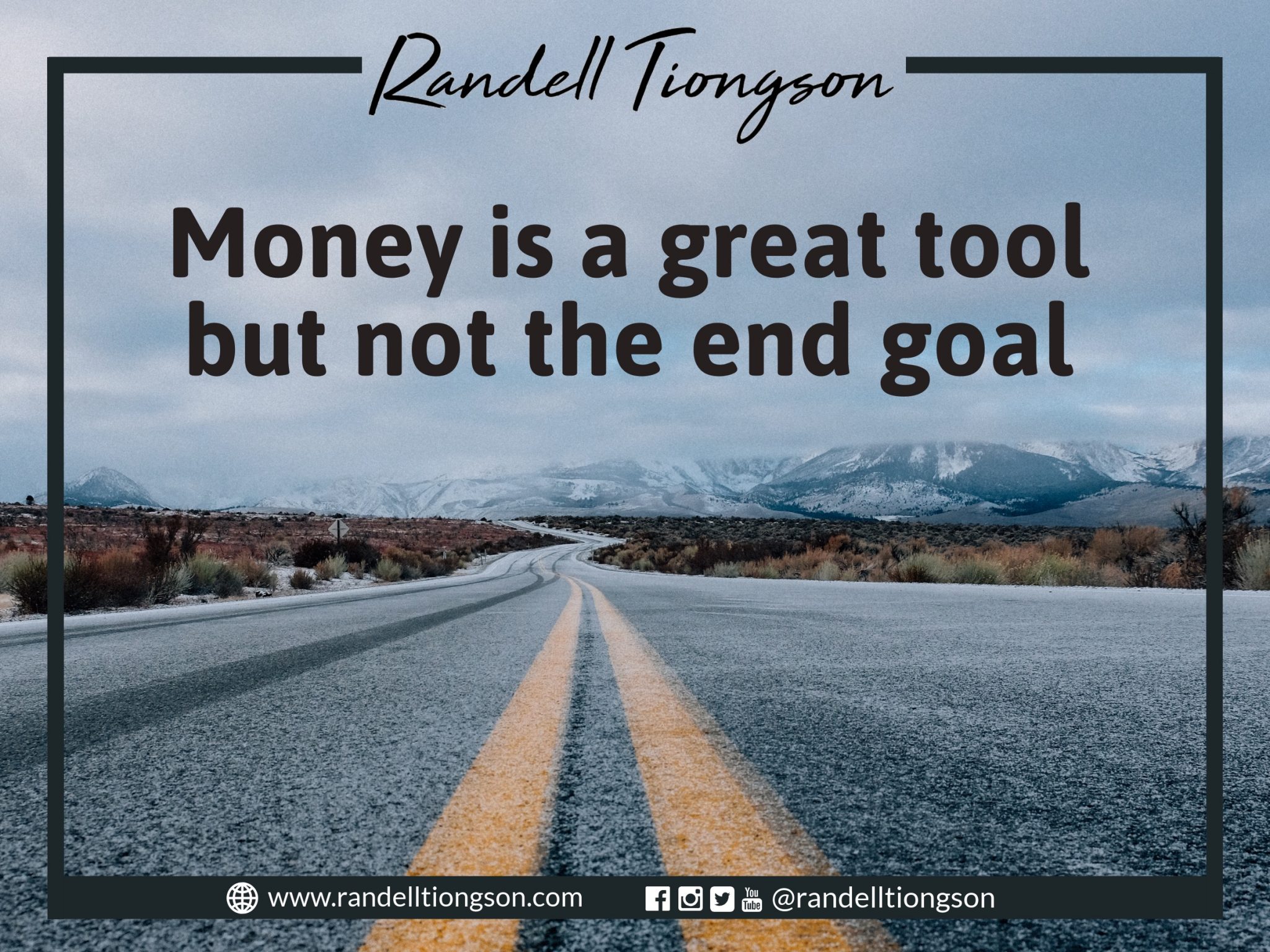
“But seek first his kingdom and righteousness, and all these things will be given to you as well.” – Matthew 6:33, NIV
———————-
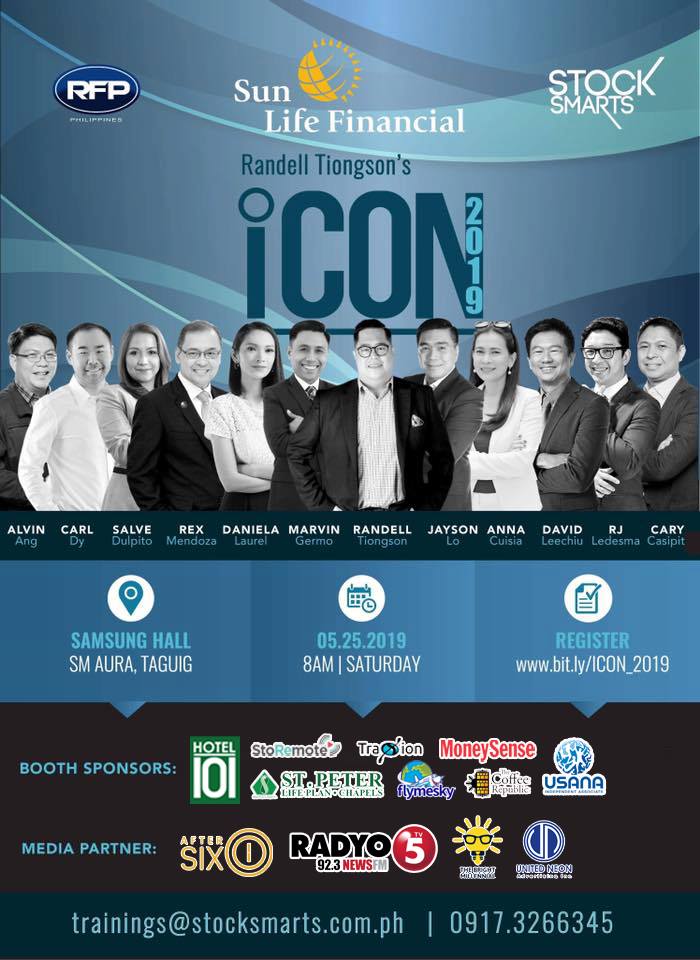
Join me and my friends at the biggest and most empowering investment conference of the country #iCON2019. We are already running on our 7th year and this year will be even bigger and better than the previous ones!
Details and registration via www.bit.ly/ICON_2019
Personal Finance Q&A
By Randell Tiongson on February 15th, 2019

I get a lot of personal finance questions on a daily basis which I always try to answer in the best possible way I can.
Let me share you some questions I received and my answers…
What are UITFs? Asked by Therese
UITF stands for Unit Investment Trust Funds, it is a kind of investment that is being offered by the trust departments of big banks. UITFs are pooled funds, where investors put money in a fund and there is a fund manager that will invest for them according to the objectives of the fund. Depending on where it is invested, UITFs can be conservative, moderate or high-risk investments. UITFs are good investments for long-term objectives such as retirement or the college education of young children. Though they are not guaranteed investments, they have proved themselves to be a good way to grow your money in the long-run. Remember that UITFs are long term investments so if you plan to use your money in the short term, do not put them in UITFs.
Should I invest my money in business or in the stock market?Asked by Jason.
Comparing a business and stocks is difficult, like comparing apples and oranges. While both are investments and both are risky ones at that, they operate and function differently. Owning a business means you are operating it yourself and you are on top of the company. You have a direct involvement on how the company operates. The benefit of having your business is that you own all the profits and the gains of the business. The downside is that should the business fail, you will bear all the losses and you may not have the competence and experience to make a business succeed. Stocks are fractional ownership of businesses, big ones at that. Buying stocks lets you have a part of a successfully big company or several companies and you stand to earn dividends or capital gain of your shares when you trade them in the stock market. Downside of stocks vs. business is your gain, an issue of scale. You stand to get a much better return for your money when your business succeeds as against stocks.
What the risks are in investing your money?Asked by Patrick
Well Patrick, the biggest risk involved in investing is capital loss. While some investments are guaranteed, the good ones where you can earn more are never guaranteed. Returns are always a function of the risk you take – the higher the risks are, the higher the potential returns. Some investments like stocks and mutual funds are fluctuating – they do not appreciate in a straight line and expect them to be fluctuating constantly. But if you invest over a long period, like over 5 years, the chances of loss of money is minimized as investments fluctuate up over the years. Low risk investments are not necessarily free of risk – the biggest risk for guaranteed or low investments is inflation. Low risk means low return and they are often below inflation rates.
Who should be in charge of the money, the husband or the wife? Asked by John
Our Filipino custom dictates that the wife should be in charge of the finances. However, our customs are not always right. Finances are conjugal and how to manage money should likewise be conjugal. I don’t think only one spouse should be given the sole responsibility on how to be in charge of the money – both should discuss and agree as to what to do with their finances. The operation of the family budget like payment of bills, balancing of the check book and the like can be delegated to the husband or the wife. Which spouse? Well, the one who is more financially disciplined should be the one – whether a husband or a wife.
Is there is a formula to be able to build wealth. Asked by Bianca
Yes Bianca, there is a formula — a fundamental process that you can follow that will allow you to build your wealth. Let me first say that achieving wealth is a process and there are no short cuts to wealth. In my book No Nonsense Personal Finance, I outlined 5 steps for wealth. First step is to increase cash flow; you can achieve this by earning more money and spending less money. Step 2 is getting out of debt – as debt will prevent you from achieving your goals. Step 3 is building your emergency fund – 3 to 6 months worth of your expenses is a good measure. Step 4 is getting insurance for your protection. Finally, the 5th step is learning to invest for your future.
Got more questions? Let me know and I will try to answer them!
Catch me at my seminars in Dubai, Japan and Manila
Dubai – www.bit.ly/RFPUAE2019 Dubai – www.bit.ly/MTUAE2019
Japan – www.bit.ly/investinginsightsjapan2019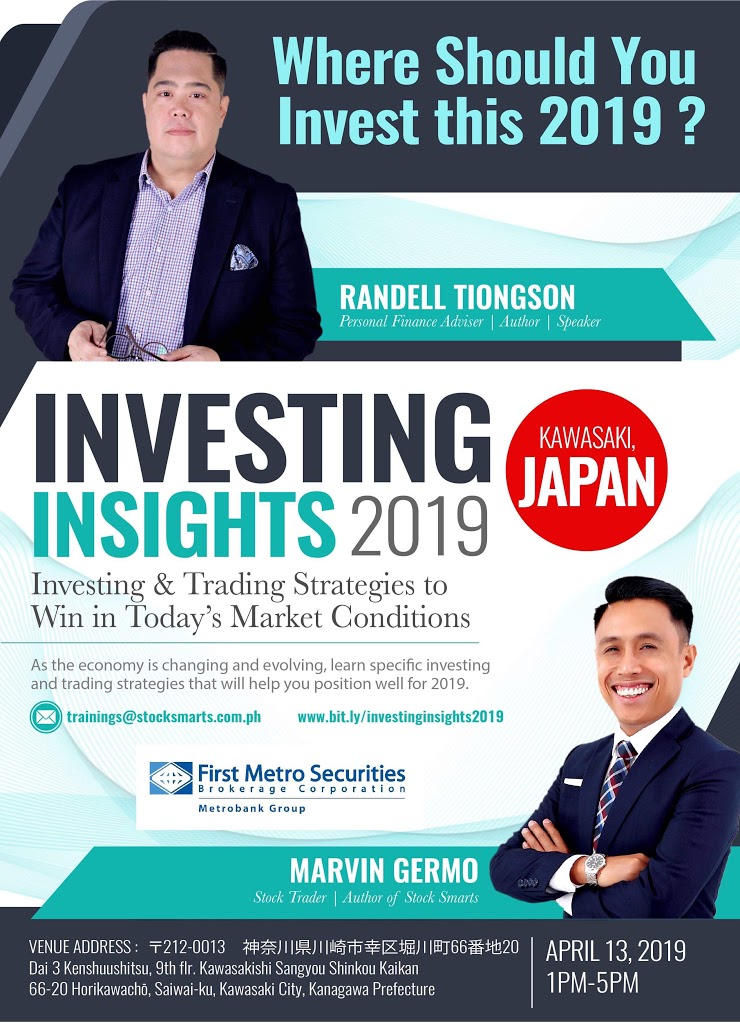
Manila – www.bit.ly/ICON_2019