I am now ready to invest
By Randell Tiongson on February 9th, 2019

Question: I have been a reader of your column and blogs and I learned much from it. I am now debt free and have some emergency funds and savings and I am now ready to invest. Where should I put my money? – Name withheld upon request, asked via e-mail
Answer:
Congratulations for being disciplined enough to be debt free, establish your emergency funds and consider investing – you are on your way to achieve financial peace!
I am sorry that I can’t give you a specific answer as to where you can invest your hard earned money as I will need to further understand your situation before I can make any recommendation. I can however give you some broad guidelines, which I hope can help you arrive into a more informed decision.
You mentioned emergency funds and savings for investing so I will try to give you my thoughts for both.
As to emergency fund, I do not recommend that you invest that as the purpose of this money is for funding against life’s emergencies. Whenever you invest money, there is always the risk of some capital loss and there will be some form of liquidity risk involved, as you may not be able to immediately convert the investment into cash. It is best to keep emergency funds into cash or near cash instruments such as time deposits and treasury bills. If you are still keen on investing your emergency fund, you may opt to put some of it in very low risk investment instruments like UITFs or mutual funds invested in the money market or bonds. Obviously, you can’t expect much return even for those funds but I suppose it’s better than what you can get from savings and time deposits. I recommend that you should only invest a maximum of 50% of your emergency funds in the instruments I mentioned and the rest should be in cash for easy access.
As to your savings on top of your emergency fund, you should consider a few things before letting go of your money. In my book, the No Nonsense Personal Finance: A Step by Step Guide, I outlined some basic guidelines:
Know you investment objective: Before you do anything with your hard-earned money, I would recommend that you first consider what your investment objective is. I often tell people that our objectives will determine nearly every action we make with regards to finance. It is crucial that you first determine the reason for the investment. What is the investment intended for? What do you wish to achieve in making such an investment? Is it for retirement, future education needs of your children, purchase of an asset, or a general fund? Knowing what your objectives are will help you choose the appropriate investment for you.
To simplify objectives, categorize the general purposes of your investments according to the results in capital growth, income generation, or both. Certain investments will yield according to your desired purpose. For instance, people buy real estate properties because of capital appreciation while some people buy them for income purposes.
Know your risk tolerance – Risk and return are two correlating factors that you must always keep in mind when investing. Some people focus too much on returns and forget about risks, while others just look at risks at the expense of returns.
Here’s a very basic principle in investing — returns will always be a function of the risks you are willing to take. The risk-return relationship is simple and yet it is fundamental. The higher the potential yields are, the higher the risks will be; the lower the risks are, the lower the yields will be as well. No amount of financial engineering can change the fundamental fact of the risk and return relationship. Determine if you are a conservative, moderate or aggressive investor. If you are a conservative investor, it is wise for you to stay away from risky investments like stocks, lest you will experience a lot of sleepless nights when markets go south.
Know your time frame – When will you need the bulk of your investments? Are you investing your money just to park it while waiting for big-ticket items such as tuition or the proper investment? Or are you investing with a long-term goal of 10 years in mind? There are short term, medium term, and long-term objectives, and there are corresponding short, medium, and long-term instruments for such. It is unwise to use short-term instruments such as time deposits or Treasury bills (T-Bills) for long term investments like retirement, education, and anything that has more than a three-year life span, as you will lose on inflation. On the other hand, you should not use medium or long-term instruments such as pooled funds (Unit Investment Trust Funds or mutual funds), equities, or variable universal life insurance for short-term objectives where you will need the funds in one year or less; you run the risk of capital loss. Emergency funds are considered short-term objectives and must only be invested in short-term and very liquid instruments.
Take time to learn more about proper investing by reading books, articles and blogs, attending seminars and go ask around from as many people as you can. Investing is not rocket science and a little effort can really help you make prudent decisions in making your money grow.
For our dear Filipinos abroad, you catch me at the following areas for my seminars: Dubai & Tokyo.
www.bit.ly/RFPUAE2019
www.bit.ly/MTUAE2019
www.bit.ly/investinginsightsjapan2019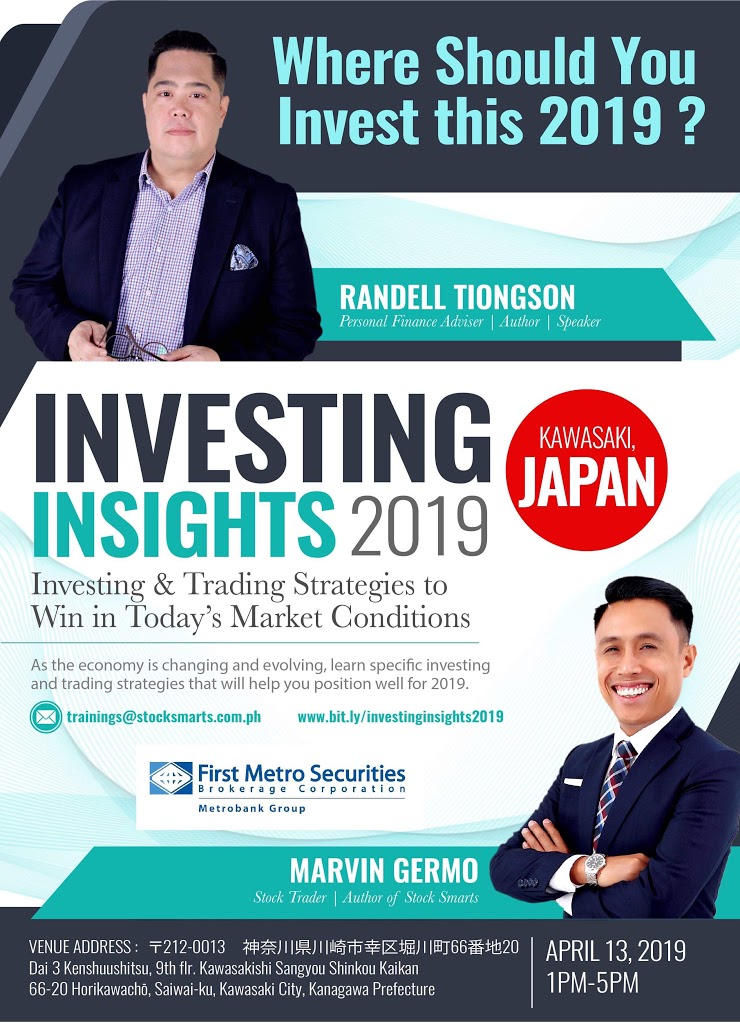
2019 Registered Financial Planner Program UAE
By Randell Tiongson on February 9th, 2019
We are excited to announce that the RFP Program will once again be available for the Overseas Filipinos in the UAE this 2019!
What is the RFP?

The Registered Financial Planners Philippines or RFP is the premiere professional body of financial planners in the Philippines. RFP Philippines promotes the value of financial planning and advances the financial planning profession.
The financial planning profession exists to help people reach their financial goals and dreams. At RFP Philippines, financial planners demonstrate and support professional commitment to education, high ethical practice standards and client-centered financial planning process.
Why should you be an RFP?
1. You can easily communicate your expertise and credibility as a financial planner.
Being a RFP® certifies that you have met the education, examination, experience, and ethics requirements of the Institute. RFP®certification expresses your expertise and credibility among your peers, and clients view RFP® certification as an indication of a qualified, reliable financial planner.
2. You can enhance your career and professional growth outlook.
There is a trend among large financial services firms that make RFP® certification a part of their hiring requirements for financial planning services while other companies reward achievement of the certification with salary increases. The RFP® certification gives you an international appeal that enhances your career opportunities.
3. You can become a financial adviser.
As a RFP® practitioner, you will advise clients on how to solve financial issues and achieve life goals. You will help your client discover their financial needs and plan their cash flow requirements at present and in the future.
4. You can increase your earning capacity.
As in any of the recognized professions, a certain level of competence is expected and financially rewarded by your employers and clients. The RFP® qualification helps you establish your competence in financial planning.
As an RFP®, you can energize and revitalize your career by leveraging the knowledge and prestige associated with one of the world’s most recognized financial planning certification.
LIMITED slots only. Enroll now: www.bit.ly/RFPUAE2019
2019 COURSE OUTLINE
Day 1, March 1 (FRIDAY)
*Fundamentals of Personal & Behavioral Finance
*Insurance Planning & Investments
Speaker/ Lecturer: Mr. Randell Tiongson, RFP
Day 2, March 2 (SATURDAY)
*Time Value of Money
*Stock Market Investment
Speaker/ Lecturer: Mr. Marvin Germo, RFP
Day 3, March 8 (FRIDAY)
*Taxation
*Estate Planning
Speaker/ Lecturer: Atty. Terence Camua, RFP
Day 4, March 9 (SATURDAY)
*Financial Planning, Retirement Planning & Integration
*Integration Group Case Study
Speaker/ Lecturer: Mr. Randell Tiongson, RFP
Is diversification difficult?
By Randell Tiongson on February 7th, 2019

You often hear the word “diversification” when investments are discussed. Diversification is important; in fact, it is considered one of the most effective risk-management tools, minimizing investment losses.
What does Investopedia (a favorite online site for investment stuff) say about diversification?
“A risk-management technique that mixes a wide variety of investments within a portfolio. The rationale behind this technique contends that a portfolio of different kinds of investments will, on average, yield higher returns and pose a lower risk than any individual investment found within the portfolio.
“Diversification strives to smooth out unsystematic risk events in a portfolio so that the positive performance of some investments will neutralize the negative performance of others. Therefore, the benefits of diversification will hold only if the securities in the portfolio are not perfectly correlated.”
Diversification is often misunderstood and its execution has always been a mystery to many. To many of us, diversification is just putting your money in different banks or buying different pieces of property in different areas. However, diversification is much more than that and here are some ways to diversify:
1) By asset class — Cash or near cash (savings or checking accounts, time deposits, treasury bills or money market accounts); fixed income (government securities, corporate bonds); equities (stocks); real estate (properties); collectibles (paintings, jewelry, etc.); enterprise (business)
2) By time frame — short term (about a year); medium term (up to about five to seven years); long term (over seven years)
3) By risk — conservative, moderate, high or speculative
4) By liquidity — highly liquid vs. non-liquid
Above are just a few ways to consider classifying your assets/investments regarding diversification. Here are some diversification tips: vary your asset classes; combine short-, medium- and long-term investments; combine highly liquid and non-liquid assets.
By practicing diversification, you are also practicing sound risk management. A properly constructed diversification strategy will minimize the risks of your investments and, at the same time, give you better yields as compared with taking an ultra-conservative position. With a good diversified portfolio, the risk of totally wiping out your wealth is highly unlikely, but at the same time, allow you to experience better growth which will be more than inflation.
But diversification also has its downside. Sometimes, a portfolio that is too diversified can also prevent you from earning properly, as the volatility of many of the players in your portfolio can cancel each other. However, having a very risk-averse position can be just as dangerous as taking a risky option, as inflation can erode the value of your wealth. The more prudent option then would be to learn diversification.
Do not be too afraid to try out diversification, it is not rocket science. Come up with a diversified program that is consistent with your investment objective, risk tolerance and time frame and you are on the road to achieving financial peace.
I really like the way the Bible talks about diversification. Yes, the Bible is a good source of investment wisdom and here’s proof: “But divide your investments among many places, for you do not know what risks might lie ahead.”—Ecclesiastes 11:2 (New Living Translation). Since the Bible advocates diversification, I am assured that it’s a great idea.
Catch me at my seminars for our Overseas Filipinos in the UAE and Japan this March and April 2019.
Registered Financial Planner Program UAE – www.bit.ly/RFPUAE2019
Money Talks UAE 2019 – www.bit.ly/MTUAE2019
Investing Insights Japan 2019 – www.bit.ly/investinginsightsjapan2019