When Economic Policies Are Not Enough
By Randell Tiongson on November 16th, 2026
Why the Philippines Needs Sound Economic Reforms, Faithful Stewardship, and Kingdom Principles
The Philippine economy is facing increasingly difficult challenges, and there are growing concerns that things may get worse before they get better.
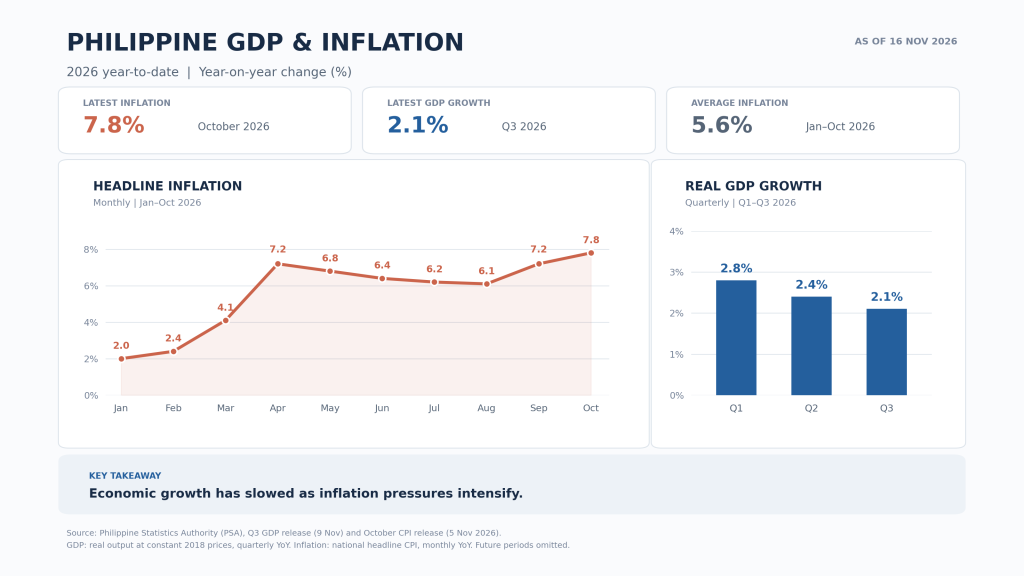
The latest economic numbers paint a troubling picture. Philippine GDP growth slowed further to just 2.1% in the third quarter of 2026, bringing economic growth for the first nine months to only 2.5%. Household consumption, traditionally one of the strongest drivers of our economy, has weakened considerably. Investment activity remains subdued, while agriculture continues to suffer from adverse weather conditions and long-standing structural challenges.
At the same time, inflation accelerated to 7.8% in October, with core inflation reaching 5.4%. The weakening peso, which recently breached ?64 against the US dollar, is adding pressure to the cost of imported goods, fuel, and other necessities. The Bangko Sentral ng Pilipinas has raised its policy rate to 5.50%, with the possibility of further tightening if inflation remains stubbornly high.
We are experiencing a particularly difficult combination of slowing economic growth and rising prices. This creates a challenging environment because measures intended to control inflation, such as higher interest rates, can also make borrowing more expensive, discourage investment, and further weaken consumer spending.
Unfortunately, these are not merely disappointing economic statistics. They represent real difficulties affecting millions of Filipino families, businesses, and workers.
The Economy Is Moving, but Are Filipinos Really Progressing?
We continue to see crowded shopping malls, heavy traffic, busy restaurants, and considerable commercial activity. From the outside, the economy may still appear vibrant. However, economic activity does not necessarily translate into economic prosperity.
Behind the activity are families struggling with rising grocery bills, transportation costs, electricity expenses, tuition fees, and housing payments. Many Filipinos are working harder but finding that their incomes can no longer support the same standard of living they enjoyed just a few years ago. For an increasing number of households, the priority is no longer improving their financial future but simply making ends meet.
Business owners, particularly those operating small and medium enterprises, are experiencing similar difficulties. Higher operating expenses, weaker consumer demand, and more expensive financing are squeezing already thin margins. Many businesses are postponing expansion, reducing expenses, and becoming increasingly cautious about hiring additional workers.
The longer these conditions persist, the greater the risks to employment, household savings, business confidence, and future economic growth.
An economy cannot be considered truly healthy simply because money continues to circulate. It must create productive opportunities, meaningful employment, and genuine improvements in people’s lives.
While global developments, geopolitical tensions, and climate-related disruptions contribute to our economic challenges, not everything can be blamed on external circumstances.
The Philippines continues to face structural weaknesses that require serious and sustained attention. We need a credible industrial policy, more productive agriculture, better infrastructure, stronger institutions, less bureaucracy, and an environment that encourages productive investment and job creation.
We also need greater accountability in the management of public resources. Every peso lost to corruption, inefficiency, or waste represents resources that could have been used to improve infrastructure, education, healthcare, and economic opportunities.
Our country does not lack talent, resources, or entrepreneurial ability. What we need is effective leadership, sound policies, and the political will to transform these advantages into sustainable and inclusive economic growth.
Stewardship Becomes Even More Important During Difficult Times
While government and policymakers carry enormous responsibilities, individuals, families, business owners, and investors must also respond wisely to the economic realities before us.
Sound financial stewardship is important regardless of economic conditions, but it becomes even more critical during periods of uncertainty.
For families, this means becoming more intentional about spending, strengthening emergency reserves, managing debt carefully, and protecting sources of income. We must distinguish between needs and wants, avoid unnecessary financial commitments, and resist the temptation to maintain lifestyles that our present circumstances can no longer sustain.
For investors, difficult economic conditions do not necessarily mean abandoning the markets, but they require greater discipline and selectivity. Protecting capital, maintaining adequate liquidity, generating sustainable income, and managing risks should receive greater attention.
With interest rates remaining elevated, selected Philippine fixed-income investments, particularly in the three- to five-year maturity range, may offer attractive income opportunities, depending on the investor’s objectives and risk profile. Equities may also present opportunities, but company fundamentals, reasonable valuations, and long-term prospects remain important considerations. Diversification, including appropriate global and US dollar-denominated exposure, may also help manage concentration and currency risks, although these investments carry risks of their own.
There is no single investment strategy suitable for everyone. Financial decisions should always consider individual circumstances, objectives, investment horizons, and capacity to absorb losses.
For business owners, challenging economic conditions require greater operational discipline, prudent cash flow management, improved productivity, and a stronger focus on developing people. Rather than simply waiting for economic conditions to improve, businesses should use this period to strengthen their capabilities and prepare for future opportunities.
Proverbs 21:5 reminds us, “The plans of the diligent lead surely to abundance, but everyone who is hasty comes only to poverty.”
Good stewardship does not guarantee that we will avoid financial difficulties, but it helps us navigate uncertainty with greater wisdom, discipline, and responsibility.
We Need More Than Better Economic Policies. We Need Kingdom Principles.
Economic policies are necessary. Strong institutions matter. Structural reforms are essential. But many of our economic problems also reveal deeper issues involving values, priorities, integrity, justice, and our responsibility toward others.
This is where kingdom principles become particularly relevant.
The Bible teaches that everything ultimately belongs to God. Psalm 24:1 declares, “The earth is the Lord’s and the fullness thereof, the world and those who dwell therein.”
This means that we are not absolute owners of the resources entrusted to us. We are stewards, accountable to God for how we use them. This biblical understanding of stewardship should influence not only our personal finances but also how businesses operate, how institutions are managed, how leaders exercise authority, and how economic policies are formulated.
Kingdom economics reminds us that wealth creation should never be separated from righteousness, justice, compassion, and concern for the common good.
A business that prospers by exploiting its workers or customers may be profitable, but it is not necessarily practicing good stewardship. A government that announces ambitious economic programs but fails to protect public resources is neglecting its responsibility. An individual who accumulates wealth while remaining indifferent to the suffering of others has missed something fundamental about God’s purpose for material blessings.
Micah 6:8 reminds us of what the Lord requires: “to do justice, and to love kindness, and to walk humbly with your God.”
These are not principles reserved for Sunday worship. They should influence our decisions in boardrooms, government offices, marketplaces, and homes.
When kingdom principles shape economic decisions, we begin to see people not merely as consumers, workers, taxpayers, or statistics, but as individuals created in the image of God, deserving of dignity, justice, and opportunity.
Economic growth is important, but growth alone is not enough. We should also consider whether that growth creates meaningful employment, strengthens families, promotes justice, and improves the lives of those who are most vulnerable.
A truly prosperous society is not simply one where wealth increases, but one where opportunities expand, people are treated with dignity, and the benefits of economic progress are shared more widely.
Our Hope Must Be Greater Than Our Economic Circumstances
Given the challenges before us, concern is understandable. We need to acknowledge the seriousness of our economic situation and prepare accordingly. But acknowledging reality does not mean surrendering to fear or discouragement.
As Christians, we must learn to distinguish between recognizing economic realities and allowing those realities to determine our hope.
Our faith does not exempt us from inflation, unemployment, business losses, or financial uncertainty. Christians are not immune to economic hardship. But our assurance rests on something far greater than favorable economic conditions. It rests on the faithfulness, provision, and sovereignty of God.
Jesus reminds us in Matthew 6:33, “But seek first the kingdom of God and his righteousness, and all these things will be added to you.”
This is not a promise that believers will always experience financial prosperity or escape economic difficulties. Rather, it is an invitation to reorder our priorities, trust our heavenly Father, and live faithfully under His rule.
While we are stewards of God’s resources, we are also His sons and daughters. Our identity, security, and ultimate hope are not found in the performance of the economy, the value of our investments, or the stability of our income. They are found in our relationship with the Lord.
This does not remove our responsibility to work diligently, plan wisely, and manage our resources carefully. Instead, our faith provides the proper foundation for these responsibilities.
We work faithfully because work is part of God’s calling. We practice stewardship because everything belongs to Him. We pursue justice and generosity because we are called to love our neighbors. And we remain hopeful because our future ultimately rests in God’s hands.
This perspective should also influence how we respond to those who are struggling. Difficult economic times should not lead us toward indifference or excessive self-preservation. They should encourage greater compassion, generosity, and a willingness to help others, particularly those who are most vulnerable.
For those entrusted with greater resources, influence, and opportunities, there is also a greater responsibility to use these blessings for the good of others.
Moving Forward With Wisdom, Faith, and Responsibility
The challenges facing the Philippine economy are serious, and there are no simple or immediate solutions. We need decisive economic leadership, meaningful structural reforms, stronger institutions, and policies that encourage investment, productivity, employment, and sustainable growth.
We cannot afford complacency, especially when many Filipinos are already struggling simply to meet their daily needs.
At the same time, there is much that individuals, families, businesses, and communities can do. We can manage our finances prudently, strengthen our businesses, develop our people, create opportunities, support those in need, and use whatever influence we have to promote integrity, justice, and responsible leadership.
Most importantly, we must remain faithful to the Lord and to the responsibilities He has entrusted to us.
Economic growth, investments, markets, and sound financial policies are important, but no economic system, however sophisticated, can fully address the deeper problems of the human heart.
This is why kingdom principles are not merely helpful additions to economic thinking. They are essential to building a society where prosperity is pursued with righteousness, where resources are managed with integrity, and where economic progress serves the dignity and welfare of people.
We may not be able to control the direction of the economy, but we can remain faithful in how we steward what God has entrusted to us.
The economic outlook may be uncertain, and the road ahead may be difficult. Nevertheless, we must continue to act wisely, work diligently, lead responsibly, and care for one another.
Because while we live and operate within the world’s economy, we ultimately belong to God’s kingdom.
Our circumstances may be uncertain, but our hope in the Lord must remain steadfast.