When should one be serious about finance? The earlier, the better. When you understand about time and investing, you will really want to start being money smart from the day that you get your first paycheck (or your profit) right? The reality is, young people often start being financially astute much later than they should — and I’m speaking from personal experience. I really have a few regrets of my youth (seems so long ago), the only ones I can think of would mostly relate to financial issues — not saving as much, borrowing too much and not investing enough.
Here’s a very helpful blog written by a good friend of mine, Jesi Bondoc. Jog, as we fondly call him, is not only a Registered Financial Planner (proud teacher I am), he is also a certified yuppie himself. When I see young people like Jog becoming more and more financially enabled, I am hopeful that the Pinoys will be financially at peace sooner than later.
——————————————-
PERSONAL FINANCE FOR YUPPIES
Jesi Bondoc, RFP
I had the privilege to speak before a handful of young professionals last month in the financial wellness week of a Telco company. It seems that more and more companies nowadays realize the importance of personal financial management for their employees’ professional development.
During the course of our workshop, we have identified several key behaviors in order to enhance employees’ income to create their own financial pipeline. It is my hope that every young professional embrace these behaviors and benefit from them.
1. Always begin with the END in mind. The journey towards financial freedom begins with a solid financial goal. A financial dream may sound similar with a financial goal but they’re not. Financial goals serve as your road map in achieving your financial desires. Your financial goal should be specific, can be quantified and should have a deadline.
2. Be comfortable with money. According to the famous writer Oscar Wilde, “the only people who think more about money than the rich are the poor”. The way you view money will greatly affect how much or how less of it you’ll have. Too much attachment to money is the reason why many people struggle to make money. Once you’re attached to something, you grow emotional about it and the more emotional you are, the less control you have. Detachment is a major reason why rich people get richer. They don’t care so much – they’re not desperate. If you don’t have money, you need to be relaxed enough to know you’re going to get it. When you have it, you need to be comfortable enough to keep some of it – and know there’s more to come. Being comfortable with money doesn’t mean that you recklessly spend every peso you earn and pray that the Lord will bless you with some more. No! Being comfortable with money simply means that you know exactly what to do once you have it.
3. Beware of the “Income Trap”. As young professionals, it easy to get caught with the idea of increasing your income will equate in improving your lifestyle. Not necessarily. Most of the time the higher your income goes up the higher the probability of ending up in a financial mess because your expenses will eventually catch up if you do not understand how to manage your spending wisely. What matters is not how much income you receive but how much surplus is left from it. Start implementing a spending plan to keep tabs on your cash outflow. Effective spending plans are great tools in managing the way you spend your money. It will help you to form smart spending habits that will eventually lead in reaching your financial goals. Spending plans should not be restrictive and difficult in nature. They should be simple, fun and comfortable to follow. You just have to allocate more portions of your spending to things that really matters to you.
4. Pay yourself first. This simply means save first before paying your bills and other discretionary expenses. It sounds simple yet many of us still struggle in embracing the need to set aside a portion of our income for our savings before spending it elsewhere. Set up an automatic savings program where a portion of your monthly income is transferred automatically to an investment or bank savings account dedicated in building your nest egg for the future.
5. Learn how the rich play the game of money. The only difference of a rich person from a poor person is the asset column on their respective balance sheets. The rich buy assets while the poor are accumulating liabilities like credit card debt, car loan, home loan, etc. To create your own financial pipeline that can augment your employment income, you need to learn how to buy assets that can generate more income for you. Investing in paper assets like stocks, mutual funds or UITFs are simple ways to start improving your asset column. Paper assets generally require lesser time to manage compared to other investment instruments making them a great investment tool for busy young professionals.
6. Giving back. There’s truth to the saying that if you want something, give it away! It may sound insane to others but it is true that through giving you’ll get more. In Hong Kong, I saw fishermen attaching a small fish to their hooks to catch more fish. Farmers give away seeds to the soil to get more seeds. Try slapping someone and you’ll get a slap on the face in return! Same with money, if you want more money try giving some of yours through tithing, donations or adopting a scholar.
Jesi Bondoc is a Registered Financial Planner and Certified Investment Solicitor. He is currently the Director of My Wealth MD and Partners, Inc. specializing in investment advisory and oversight. He also conducts wealth planning seminars and workshops for various corporations in the Philippines. You can reach him at jj_bondoc@yahoo.com or jbondoc@mywealthmd.com and for more info about Registered Financial Planner, please visit www.rfp.ph or email info@rfp.ph
OFWs and financial education, the die has been cast
By Randell Tiongson on April 7th, 2013
Fresh from conducting a total of 8 talks in my 11 day sojourn in the UAE, Oman and Qatar recently, I came home with fresh perspective of how our dear heroes are doing abroad. I gave a total of 5 talks in Dubai (UAE), 1 in Muscat (Oman) and 2 in Doha (Qatar) with a total estimate of about 1000 to 1200 OFWs in attendance. The talks were varied but all had a central theme which was money.
I got involved with the financial advocacy for OFWs in 2004 when the late Ka Tonyang Binsol, an OFW in Japan asked for my help to organize finance talks for OFWs who are back home for a visit. We were able to run successful talks which ignited my burning passion to promote financial education for the Pinoys. Sadly, my friend Ka Tonyang (loved by many, me included) passed away which temporarily put a stop on my outreach for the OFWs. Despite my absence in the advocacy for OFWs, I transferred my focus to pushing financial literacy to the Pinoys in general – something I have been doing and will be doing for a long time, but my desire for the OFWs remains.
5 years after meeting Ka Tonyang, I was blessed to be introduced to another OFW advocate, someone who has been a staunch supporter of our dear heroes – Ms. Susan “Toots” Ople. Toots, along with his partner Fort Jose of the Blas F. Ople Policy Center (BFO) asked me if I am interested in teaching OFWs about finances and I was so ecstatic to be given the opportunity to do so; the start of a wonderful partnership. In the same year, I was invited by Ms. Ople for a couple of speaking engagements in Hong Kong and other locations to reach out to the many OFWs who can benefit much from financial education. From then on, my passion to reach out to the OFWs has been rekindled and burning and I am blessed to be able to interact with many other advocates.
I have been blessed to speak and teach in 7 nations already namely Hong Kong, Singapore, Macau, Israel, United Arab Emirates, Oman and Qatar and there are arrangements being made for Saudi Arabia and Japan for this year. I am leaving again for Singapore to run programs and this year will be my fourth consecutive year speaking and teaching in Singapore. If plans go well, I may find myself in the Middle East again before the year is over – something I am very thankful to the Lord for.
Being an advocate to OFWs and the Pinoys in general is not an easy task – just ask the many other advocates. There are many hurdles but the biggest stumbling blocks would be
our behaviour and mindsets when it comes to personal finance. Our culture is a unique one and proper but basic money principles don’t seem to be ingrained in it, unfortunately. The OFWs are placed in a peculiar situation where they are earning much more than their counterparts at home and yet the financial strains they experience are just as disheartening. There continues to be problems with savings and worse, issues of debt. In my trip to Dubai, a lot of people were telling me of debt woes of the OFWs and many of them actually end up in jail because of debt. What is the most common problem of our OFWs? It is too much financial dependence of their families, which is why most of them end up remitting all their income that ends up being spent and left with very little or no savings at all. Our brothers and sisters off shore feel that they can’t handle the burden anymore and many are on the brink of desperation. I feel so helpless whenever I speak to them as all I can only offer are few words of advice, a listening ear and a prayer. On top of financial problems, there are many other problems that they encounter – unfair employment treatment, loneliness, among others.
But, there is much to be ecstatic about OFWs and financial education as well. From 2004 to today, I have seen an enormous growth in finance advocacies and advocates amongst the OFWs. I’ve also witnessed stark improvements in the financial literacy of many OFWs as well. Although it is far from ideal, I believe that there is already momentum in the arena of financial education among them, and this is largely attributed to the OFWs themselves. In
Dubai Coaching Event
the last 3 or 4 years, OFWs has successfully used social media as a means to spark interest on financial literacy. When the OFWs themselves began championing financial education in a more aggressive way and thanks to the internet, I believe it is only a matter of time before we see a financially enabled OFW population. Everywhere I go now, I have the chance to speak with them, sit down with them, break bread with them and most of time, I end up being encouraged myself by their passion to be financially enabled. Every country I go to, there will be advocates who will arrange for me to speak and teach and they do this not out of any gain but out of passion to help. They have also been busy organizing their own forums, seminars and outreach groups all in the name of financial education. There are many groups out there but I would like to honor two groups whom I have been working with and I have seen their relentless passion to see a financially empowered OFW citizenry: The Global Filipino Investors (TGFI) and OFW Usapang Piso under the passionate leaderships of Floi Wycoco and Burn Gutierrez, respectively. These mighty advocates are not only making waves, they are changing the lives of many OFWs. Of course, their groups are successful because of their equally passionate core teams and members so kudos to all of them! I would also take time to honor the advocates who have been instrumental in my being able to speak to many OFWs like Charma de Villa (OFW Usapang Piso Israel), Allan Miranda (TGFI Dubai), Siegfried & Leonora Ras (OFW Usapang Piso Singapore), Leo & Normie Pascua (OFW Usapang Piso Dubai), Bernard & Rhea Anduyon (OFIEM Qatar), Rex Holgado (Alkansya ni Juan Singapore) and my dear friend Jess Emerson Uy of a co-advocate based in Singapore. There are many more OFWs who I am not mentioning but I want to thank you and the nation should thank you too.
The advocacy of financial education for OFWs is well on it’s way, it has started, it is moving and it is growing. “Alea iacta est,” the die has been cast, it is now only a matter of time and more importantly, a matter of scale.
Catch me at 2 upcoming events – Singapore event and iCon 2013 at the SMX. Details below:
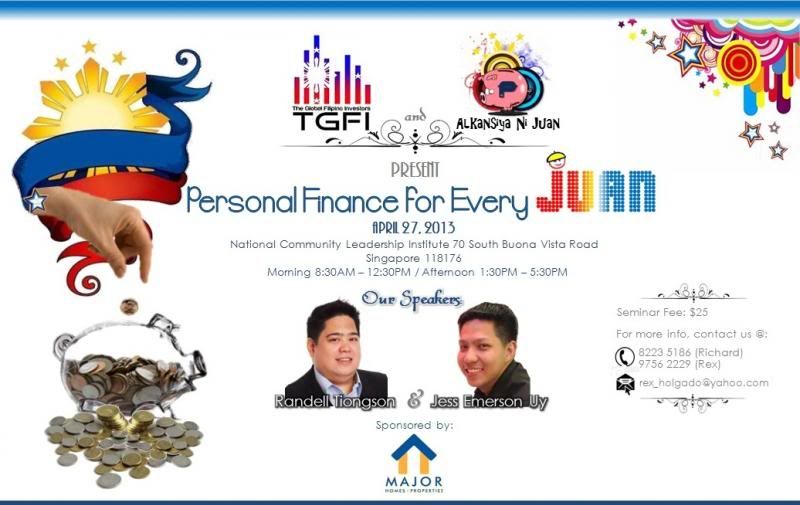
Great news to my Singapore friends, I will be back there on April 27 to conduct 2 personal finance seminars!
This is the 4th year that I am running a program in Singapore and I am so blessed to see how personal finance seminars have helped improved the financial lives of our OFWs based in Singapore. I will be joined by my friend Mr. Jess Uy, a Filipino Investment Adviser based in Singapore for the said events.
I am excited to talk about achieving financial peace through a process I will outline in the seminars. There will be 1 session in the morning and another in the afternoon but seats are limited so it is best to register as soon as you can.
All the details can be found in the e-poster below or you may send an email to floi@tgfiph.com or rexon.holgado@gmail.com for your inquiries.
Want to learn how to manage your finances better?
Register now and get a free copy of my e-book. Start your financial planning journey today!

 currently the Director of My Wealth MD and Partners, Inc. specializing in investment advisory and oversight. He also conducts wealth planning seminars and workshops for various corporations in the Philippines. You can reach him at jj_bondoc@yahoo.com or jbondoc@mywealthmd.com and for more info about Registered Financial Planner, please visit www.rfp.ph or email info@rfp.ph