Best performing Equity UITFs (YTD)
By Randell Tiongson on August 28th, 2013
The equity market has been declining and virtually wiping out gains for the year. The argument by many is index funds perform better than manage funds but it seems that argument does not hold true for the Philippine situation.
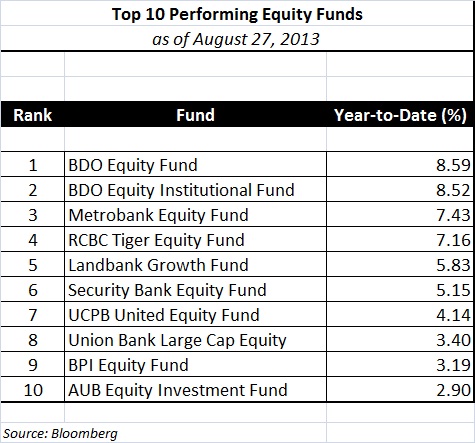
Despite the massive decline of the market, 6 out of the top 10 equity UITFs was still able to post beyond 5% growth in their year-to-date performances, as of August 27, 2013.
The following are the year-t0-date results of the the top 10 Equity UITFs:
No Nonsense Personal Finance, the Conference!
By Randell Tiongson on August 14th, 2013
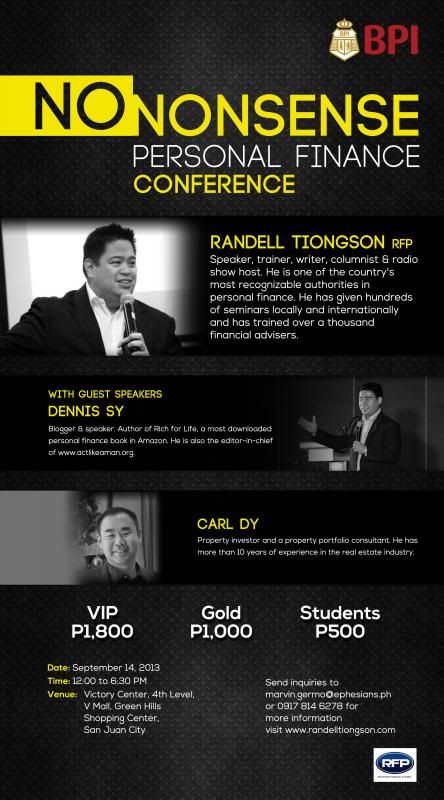
Here it is, the No Nonsense Personal Finance Conference!
Learn process of achieving true financial peace through a step by step understanding on the foundations of personal finance. I will be discussing the different steps to a financially free life in detail from Cash flow, Debt Management, Investing, etc.
Joining me for this life-changing learning event is DENNIS SY, the author of the best-selling Amazon book Rich for Life and also the Editor-in-Chief of one of the country’s most admired website, www.actlikeaman.org
Also joining me for the first time is CARL DY, a real-estate investment expert. Carl has over a decade of experience in the many facets of real estate and will share his proven techniques on creating your wealth through real estate.
This event is on September 14, 2013 (Saturday) from 12:00 noon to 6:30 p.m. at the Victory Center, 4th Level of V Mall in Green Hills Shopping Center, San Juan City.
Ticket prices are P 1,800.00 (VIP), P 1,000 (Gold) and P 500 (Students).
To register or for inquiries, please send an email to nononsense@marvingermo.com or text/call 0917-8146278
Why an emergency fund?
By Randell Tiongson on August 11th, 2013
Emergencies happen.
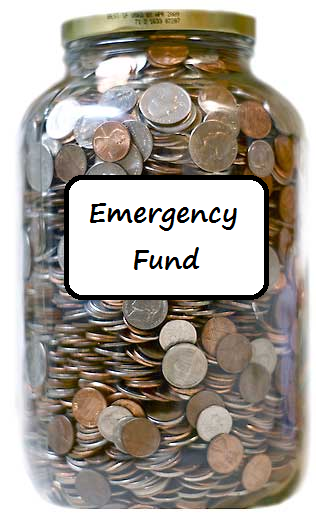 This fact remains unchanged, emergencies happen whether we like it or not. An emergency can be minuscule or it can be catastrophic. While we can handle small emergencies like changing the batteries of your tires, replacing a home appliance or a minor injury, some emergencies can be stressful. Major health breakdowns, loss of employment or business failure are some of the emergencies that we should prepare for.
It is foolish to think that we will never undergo an emergency in life and most of the time emergencies cost a lot of money. The third step in achieving financial peace is setting up your emergency fund.
Before starting on emergency fund, it is best if you know how much you actually spend in a month. Many people I know are clueless as to how much they spend monthly. During a financial planning session, I asked someone how much he spends monthly. He told me that he wasn’t sure as to the exact figure so he said he will just give me a ballpark figure. The figure he gave me was P40,000 to P80,000. If the discrepancy was about P5,000 to P10,000, it would have been understandable but P40,000? I politely asked the person to really think about all his expenses, examine his bills, record his spending and get back to me.
If you already have a monthly figure, you are now ready to start building your emergency fund. The rule of thumb for emergency allocation is somewhere between 3 to 6 months of your monthly expenses. 3 months is good, 4 months is better, 5 months will be great and 6 months is excellent. Emergency funds come in handy for a variety of reasons: medical emergencies, loss of employment, car breaking down, appliances needing sudden replacement, illness in the family and so forth and so forth. However, the most common reason for establishing your emergency fund is for a sudden loss of income. If you are an employee, there is no such thing as employment security anymore. Job security is actually a thing of the past. A very gainful employment can suddenly cease owing to the volatile nature of business and the economy. I have given countless seminars to employees who went through retrenchment for me to ignore the fact that losing a job, despite your stellar performance is now a common occurrence. Markets and the economy can have sudden changes and it is unfortunate that companies often see the need to downside just to remain profitable. For business owners, the risk of loss of income is likewise probably, if not more. Business ventures are speculative in nature therefore business failures do happen. I often advice entrepreneurs to set aside money for emergency funds just in case the business fails or when the business suffers temporary setbacks. Regardless of the nature of your employment or profession, an emergency fund is truly a prudent thing that we should all establish.
What is the best way to establish an emergency fund? It’s in Step 3 of No Nonsense Personal Finance: A Step by Step Guide. To order, CLICK HERE.
“A prudent person foresees danger and takes precautions. The simpleton goes blindly on and suffers the consequences.” – Proverbs 27:12, NLT