Stocks or Stock Funds?
By Randell Tiongson on February 9th, 2015
 QUESTION: I am ready to start investing and I would like to invest in equities. Is it better to invest in stocks directly or through pooled stock funds like UITF or mutual funds? —Name withheld per request, asked via e-mail
Answer: As a financial and investment planner, we need to subscribe to the principle of suitability. Without sufficient information, it wouldn’t be prudent of me to categorically say one would be better than the other. The answer really depends on you—if you are knowledgeable enough to select your own stocks, size of funds, and if you have enough time for investing.
However, to help you make a more informed decision, let’s discuss the advantages and disadvantages of both types of investing.
On individual stocks
Advantages :
Control—Buying your stocks directly gives you control over what and when to buy or sell.
Residual income—If you buy a stock with a good dividend payout, then you don’t have to watch the price movement anymore. As long as the company is earning and declares dividends, you will get dividends.
Maximized returns—individual stocks that are growing may beat the market and can give you better-than-average returns. Many stocks beat the index last year.
Potentially better returns—with proper selection and assuming that you are very good at selecting market performers, the growth of your own stock portfolio can outperform the stock market index and many stock funds.
Fees—buying your stocks directly from brokers usually means lower fees as fund managers charge a higher investment management fee compared to stock brokers.
Disadvantages :
Time-consuming—before investing, you should spend enough time thoroughly understanding how stock market investing works. You should also accumulate enough knowledge of both fundamental and technical analysis. Fundamental analysis means you must be able to read and understand financial reports of the companies you would like to invest in, the general condition of the industries and market trends to which these companies belong to, general knowledge of macroeconomics and even the management of the corporations you would like to own shares of, etc. Technical analysis will require you to constantly study charts on price averages, trading volumes and a multitude of technical market theories like Dow theory, Relative Strength Index, Elliott Wave theory and more. While fundamental and technical analysis is not rocket science, it takes considerable time for you to learn them properly. Enrolling in a class like Marvin Germo’s Stock Smarts is a good way to start.
Diversification—all investment professionals will always recommend you to diversify. No amount of study and good performance in the past will guarantee the performance of a particular stock in the future so having several and properly selected stocks is always a prudent thing to do. Unless you have a very big capital for investing, you will be limited to the variety of stocks you can carry in your portfolio.
On stock funds
Advantages :
Professional fund management—this is perhaps the biggest advantage of pooled funds like UITFs and mutual funds. There is a dedicated team of investment experts that looks at investment opportunities and is investing the money according to the investment objectives of the fund. It is common to see CFAs or Certified Financial Analysts leading or being part of these investment teams. Good fund managers are clinical and logical investors and are not easily swayed by emotions as compared to individual investors.
Capital requirements—most of pooled stock funds have low capital entry requirements. One can invest in a fund for as low as P 5,000 to P10,000, with other providers requiring a monthly contribution of as low as P1,000 per month.
Diversification—all stock funds carry well-diversified stocks in their portfolio, usually blue chip or premium stocks. Since these are pooled funds, there are economies of scale in place; fund managers will be able to purchase different shares. Proper diversification will ultimately result in reduced portfolio risk.
Disadvantages :
Fees—While not all stock funds charge the same range of fees, these fees are usually much more than broker fees as there are costs involved in managing funds. Some funds even charges entry and exit fees, which can reduce the returns of your investments. Some funds are being sold through agents and advisors and commissions would need to be paid to them.
Control—you have no say on which funds you want or don’t want in your fund as this is already delegated to the fund managers. You also can’t modify the weight of the stocks inside a stock fund as fund managers follow maximum exposure limits per stock to ensure proper risk management practices. Even if you want more PLDT or Jollibee shares in your portfolio, your fund will only have a limited exposure to said stocks, like 10 percent.
The answer to your question is dependent upon you knowing the pros and cons of individual stock investing or through a pooled equity or stock fund. If you are a new investor, I recommend you invest in a stock fund first and as you get to understand how the stock market works and develop your competency in investing, you may want to start investing in individual stocks. There are no perfect investments and there are many ways to build your wealth, chose a strategy that you will be most comfortable with.
Do not forget, whether investing in stocks by yourself or through a fund, it pays to invest first in investment education.
Money Talks UAE
By Randell Tiongson on February 5th, 2015
The biggest finance event for the OFW in the United Arab Emirates will happen this March 20, 2015!
Be part of the learning by attending this life-changing event and learn from the experts who have a heart to help bring financial education to the OFWs!
To register, CLICK HERE or email dubaifinancialevents@gmail.com

My guests for this conference are all advocates for financial literacy and have extensive training & experience in finance and investing.
Allan Miranda – Allan is the most recognizable OFW in UAE when it comes to financial literacy. He has been conducting successful seminars in Dubai and Abu Dhabi for a few years now and he is seen as the champion of the OFWs when it comes to financial enablement. He is based in Dubai, UAE.
Burn Gutierrez – Burn is the founder and main driving force behind the hugely successful OFW Usapang Piso forum and the Angat Pilipinas Coalition. Due to his efforts, thousands of OFWs are becoming financially abled through his extensive work using the internet and now even live events in many parts of the world. Burn’s team is composed of many volunteers and leaders and virtually every city in the world where there are many OFW’s. He is based in Al Khobar, Saudi Arabia.
Bernard Anduyon – Bernard Anduyon was the immediate past President of the Overseas Filipino Investing & Entrepreneurship Movement, a group that is almost single handedly transforming the financial lives of the OFWs in Qatar. Doha has a high concentration of financially abled OFWs because of the efforts of Bernard and his movement. His group has been deputized by the Philippine embassy in Qatar to provide financial education to the OFWs in that region. He is based in Doha, Qatar.
Jess Uy – Jess is known as the international investing expert and has been active in investment education and financial planning amongst many OFWs. He has successfully conducted seminars in many countries like Japan, Brunei, Dubai, Qatar, Hong Kong and Singapore. Jess is based in Singapore.
Don’t miss this!
2015 Outlook, part 12
By Randell Tiongson on February 4th, 2015
Years of steady structural reforms under 4 Presidents, improved demographics, technology shifts and many other factors have been factors behind the Philippine growth story. I would like to personally thank the BSP for being a strong institution that has made all this growth a reality.
As I close this 2015 Outlook series, I believe that the best way to do so is to feature the views of one of my favorite economic icons in the country, BSP Deputy Governor Diwa Guinigundo. How I wish more and more people can learn from him which will not only give you wisdom, it will help you with your faith.
The 2015 Outlook of BSP Deputy Governor Diwa Guinigundo
I continue to see the Philippine economy performing in accordance to its higher potential capacity. Four factors support this trend that many people may not be exactly aware.
One, with sustained technology application, total factor productivity has improved over the years. Two, economic efficiency has gained more traction. Three, labor market dynamics have been favorable with more educated, more trained graduates joining the labor pool. And finally, demographic factor has been supportive with more young people keeping the dependency ratio relatively low.
What drove these growth-positive factors have been the twenty years of steady policy and structural reforms. These are  clearly a demonstration that the Philippine Government has attained a good sense of governance. Four presidencies have continued with building institutions. If nations fail because of bad institutions, one can therefore argue that the Philippines has achieved strong resiliency because it has been heavily engaged in institution building even through the Global Financial Crisis in 2007-2009.
It should not therefore be surprising if I will uphold the government target of 7-8 percent economic growth in 2015 and 2016. I see more diversified sources of growth: more investment and public spending supporting private consumption, manufacturing, construction and agriculture contributing to the growth process complimentary to services. That growth range has been achieved at some point in the past, I don’t see any reason why that should be elusive in the future. What we need to see is more infrastructure and infrastructure.
With investment grade continuing to go up, both domestic and foreign investment should remain bullish about the Philippines. Infrastructure including power should remain the focus of these investments.
With good supply prospects and pro-active monetary policy, helped by the decline in oil and other commodity prices, I see inflation averaging at a rate comfortably within the lower target range of 2-4 percent for both 2015 and 2016. The BSP and the national government have good monetary and fiscal space, respectively, to continue promoting price stability and good public finance.
On the external front, I see our initial forecast of sustained external payments surplus continuing to be broadly appropriate. The balance of payments should be able to bounce back strongly from a shortfall in 2014 to a surplus in both 2015 and 2015, with the current account expected to show increasing positive position of at least $6.0 billion.
These are premised on one, recovery in the global economy but at an uneven pace. This dimension is important because unevenness should lead to divergent monetary policies. US is turning the corner so I expect it to start preparing the stage for some tightening which could result in some capital outflows in the Philippines. Europe and Japan remain soft so monetary policy is needed to be accommodative which could drive some capital to flow to emerging markets including the Philippines. China and India are the other difficult challenges with structural issues threatening to pull them down so we should see a generalized easing among many central banks. All told, the asynchronous policies could pull each other apart and generate some volatilities in the global and regional financial markets. The Philippines should be very vigilant in monitoring these developments and should be prepared to act decisively as necessary.
I also expect to see our strong and stable banking system continuing to provide additional resiliency to the economy. Financial intermediation is expected to remain supportive of economic growth. With key reforms in place and expected to be pursued, market confidence should remain strong and this is something that does not come by easily.
There would always be some risks even at the tail end. This is the reason why the BSP is always doing stress tests and scenario building exercises to ensure we are not surprised by external shocks. This is the reason why we have a stable of early warning systems on the key sectors of the economy including the business cycle.
So paraphrasing Einstein, let me say that what is incomprehensible about the economy is that it is comprehensible.
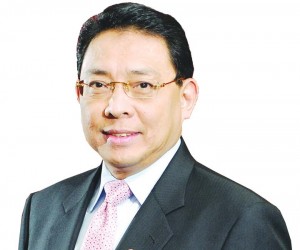 Mr. Guinigundo is the deputy governor of the Bangko Sentral ng Pilipinas in charge of monetary policy and operations, international relations and operations, currency management and regional monetary affairs. He was the Philippines’ representative at the IMF, Washington, DC as alternate executive director. Previously, he was head of research at the Southeast Asian Central Banks Research and Training Center in Kuala Lumpur. At present, he chairs the SEACEN Experts Group on Capital Flows and a member of the SEACEN Executive Committee. He sits at the NEDA Board, National Food Authority Council and National Home Mortgage Finance Corporation Board.
Outside government, Mr Guinigundo is the senior pastor of a local Christian church, Fullness of Christ International Ministries, and advises the BSP Christian Fellowship. He leads in the nationwide Touching Heaven Changing Earth which aims to unite the body of Christ in the Philippines.