Investments for Retirement
By Randell Tiongson on July 25th, 2016

Question: Hi Randell! Good morning! After browsing the net for Filipino personal finance tips, I learned about you. And after reading your articles, I’m very much driven to start investing. I’m already in my 30s and wishing I started earlier. But I can’t dwell on that anymore, so I’m ready to start now. As you keep saying, “the best time to invest was Tuesday, the next best time to invest is today.” With that, I know I should start investing, but where? With the multiple investments available, I don’t know where to start. It’d be great if you could help me on this. Thank you very much and God bless! — Carlo via Facebook
Answer: Hi Carlo! Thank you for messaging me. I’m sharing your query here in my column because I’m sure many Filipinos can relate to your situation. Many hold off saving for retirement because of the mentality that there are still many years left to save, but as you learned, the best time to invest was Tuesday, and the next best time is now. Don’t wait until you’re nearing retirement because investments are meant to be long-term. With that in mind, now we know that we should go for investment vehicles that are more for the long term. So what are these investments?
Property
Real estate is probably the favorite investment of Filipinos. While less than 1 percent of the Philippine population invests in stocks, bonds, and mutual funds, 7 in 10 Filipinos own their homes, according to the Bangko Sentral ng Pilipinas’ (BSP) 2012 Consumer Finance Survey.
Real estate is an advisable investment for retirement because the value of property appreciates through the years. Real estate property isn’t like a time deposit which gives you interest after a year (or less). You won’t make much by selling your property just after 6 or 12 months.
Stocks
Another investment vehicle is stock investing. Stocks are advisable for the long-term because they are risky. This means that the prices of stocks go up and down over a set time period, and you can lose money. One way to decrease your risk and avoid losses is to hold your stocks for the long-term, which makes stocks perfect for retirement. I recommend people to keep their stocks for a minimum of 10 years.
Seeing as you are in your 30s, you have about another 25 more years before you reach retirement age. That’s 20 years more than my suggested 10 years to spread your risk.
Pooled funds
I purposely put ‘pooled funds’ after ‘stocks’ because they are closely related. If you want to buy stocks of SM, Ayala, or Jollibee, you would have to buy them individually through a stock broker or your online trading platform. With pooled funds, be it a mutual fund or a UITF, you get a group of stocks in one basket or fund. The pooled fund can have SM, Ayala, and Jollibee stocks, depending which equities the fund manager buys. The fund manager does the investing for you. He picks what stocks go into the pooled fund; all you have to do is make an investment deposit and keep track of your investments once or twice a year. It’s also important to know that there are different kinds of pooled funds, there are funds consisted entirely of stocks, others of bonds, while some funds offer a combination of different securities. For the purpose of retirement, and for Carlo who has about 25 years until retirement, a stock or equity-based pooled fund is best for a retirement which is still far away.
With three investments to choose from, you have a clearer idea of where to put your money for retirement. Now the only thing that’s left is to head to the bank (for UITF pooled funds) or a brokerage firm (for stocks and mutual funds) to fill out your application and open an investment account.
However, there is no such thing as a so you will need to diversify.
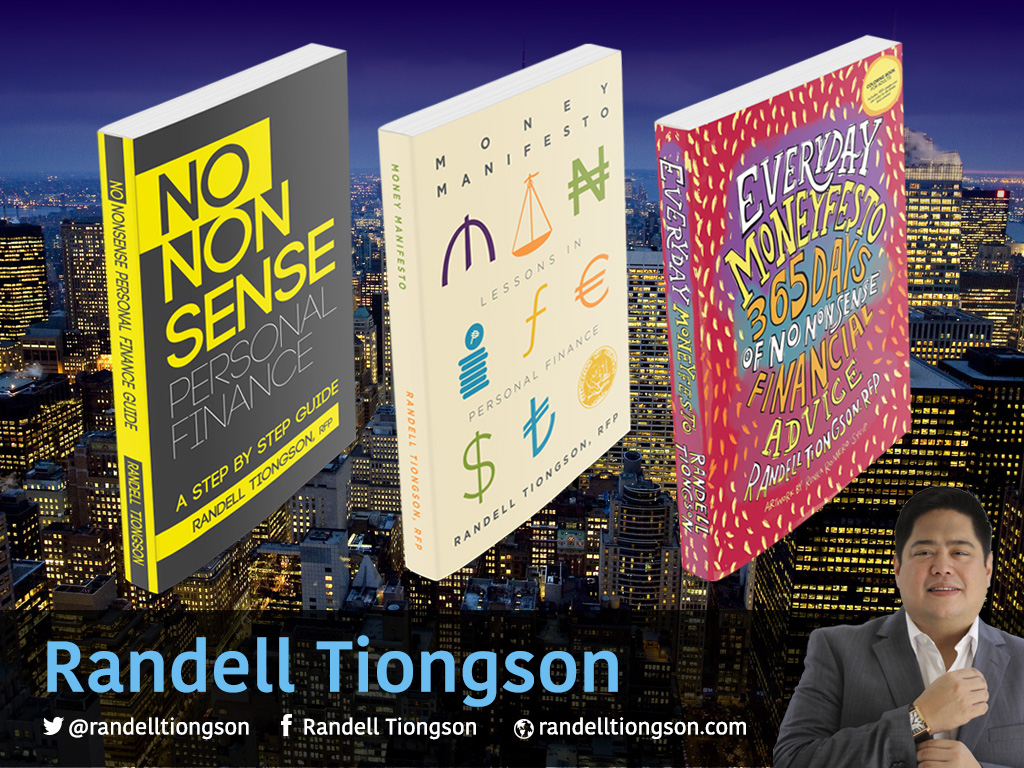
Want a copy of my books? You can order directly from us. Just e-mail michael@randelltiongson.com
What to do with your retirement fund
By Randell Tiongson on July 19th, 2016
Question: Where should my parents invest their retirement fund and savings?—James Magsumbol via Facebook

Answer: You and your parents are blessed to belong to the minority of Filipinos who have prepared for retirement. It is alarming to note that only a very small percentage of Filipinos prepare for retirement, so they end up being dependents of their children by the time they hit their golden years.
It is a good idea that you are asking about how to invest the retirement fund and savings of your parents. Many retirees make the mistake of not investing money during retirement for they fear they will lose their money or they just want to keep their cash.
While I agree that the bulk of retirement fund and savings should be liquid, part of the fund should be invested not for the sake of capital growth but as a means to preserve the purchasing power of your parents’ funds.
Inflation will not retire just because your parents did. Their retirement funds will still need to grow to catch up with inflation, which is why I recommended investing in some investments that can outperform inflation like bond funds or even balanced funds (mutual funds or UITFs).
Many retirees become short-term oriented when it comes to their money. But the fact is, they will probably live about 15 to 20 years more during retirement (longer hopefully). However, it is crucial to limit the allocation to maybe a maximum of 20 percent of their total money to the investments I mentioned as they are not guaranteed.
I would recommend that you sit down with your parents and take a look at their finances. Establish their monthly needs and go over their forecasted expenditures.
You may want to put as much as 12 to 24 months’ worth of expenses in cash or near cash instruments like savings accounts, time deposits or even money market funds. The rest of the funds can be allocated to other kinds of investments, but always be mindful of the investment risks involve.
After allocating for cash and near cash investments, you may want to consider some mutual funds or UITFs—a good ratio would be 70 percent on bond funds and 30 percent on balanced funds.
Bond funds are relatively safe and, while they are not guaranteed, they are the least volatile among the pooled investment funds. Since bond funds are relatively low-risk investments, don’t expect very good returns from them—they will perform better than inflation but not much better; 2 percent above inflation is a more realistic expectation of bond funds.
The remaining 30 percent can be placed in balanced funds, which are a combination of bonds and equities making them riskier than bond funds. However, the risk also means better returns, and you will need such growth to combat the diminishing impact of inflation to your parents’ retirement funds.
Since you did not specify the age of your parents, my recommendations are meant for retirees that are still not too senior. As your parents age, say 70 to 75, you may want to scale down their investments to lesser risk by removing the balanced funds, reducing the bond funds and greatly increasing their cash and near cash investments. As your parents hit 80 years old, you may want to keep all their funds in cash or near cash investments.
My recommendations are really just some benchmark figures as every situation is unique and people may have different objectives. Be prudent with your parents’ retirement fund. I hope this helps.
Level Up Sales goes to CEBU
By Randell Tiongson on July 6th, 2016

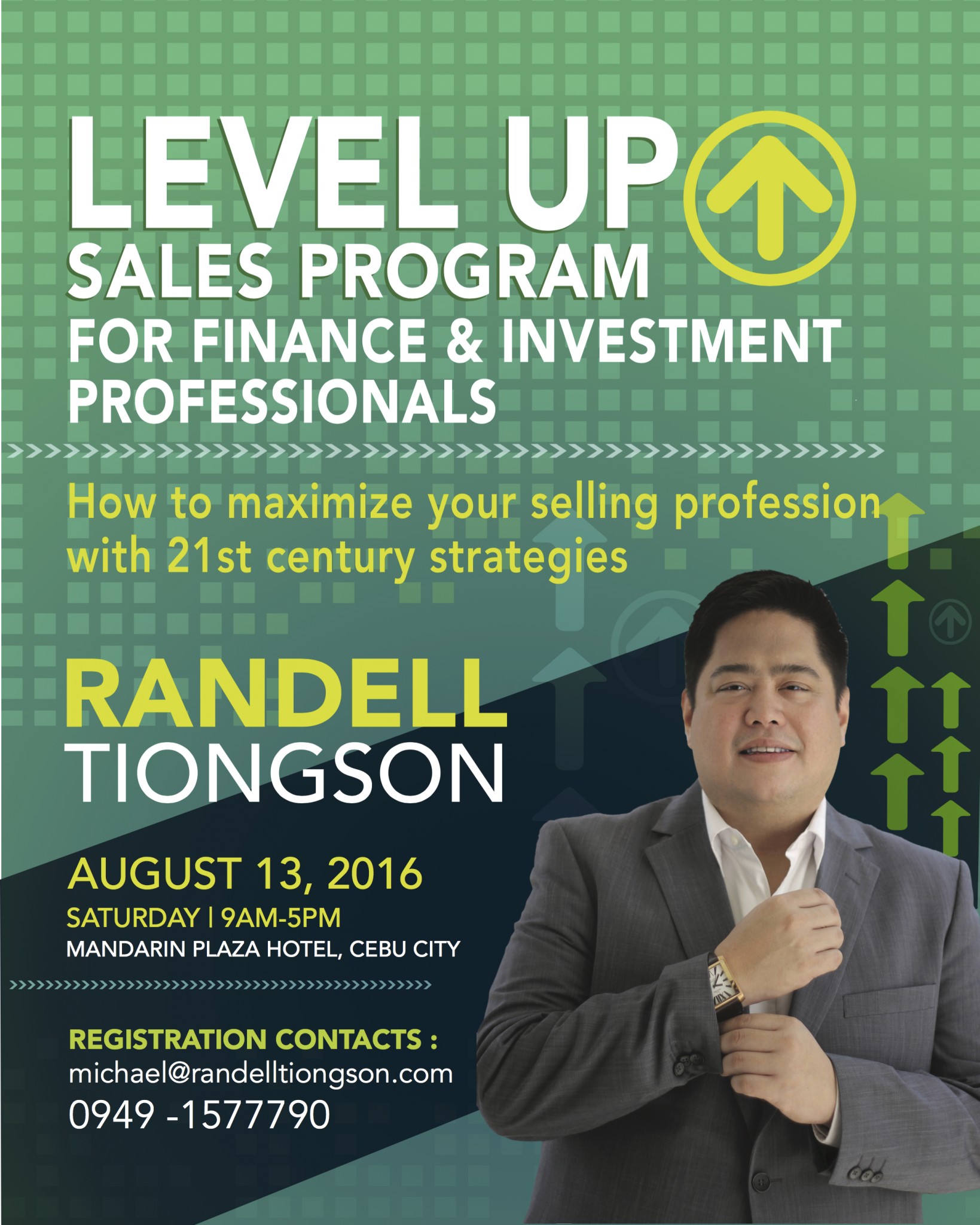
Are you in the profession of finance and investment sales and you are from Cebu? Join me as I bring my high value sales program that will help you level up!
Due to many requests for me to conduct my sales program in Cebu, I will be running the program on August 13, 2016 at the Mandarin Plaza Hotel, J. Solon Drive, Cebu City. The program will run from 9:00 am to 5:00 pm and will truly be an empowering program for the sales professional.
What do the participants say about this program?
“Randell Tiongson’s Level Up Sales Program is both timely and relevant because it provided key concepts on how to address the needs and behavior of the market today. I highly recommend it to sales professionals who would want to augment their skills and improve their sales performance”. – Ramon King III, Sales Director of Alveo Land Corp.
“Randell’s Level Up Program is highly recommended to all sales professionals. Satisfaction guaranteed!” – Jess Uy, Global Investing Advocate
“Randell’s Level Up program is for the serious minded financial planner who’s now ready to spread her wings and soar to new heights. Randell had condensed into a whole day program his many years of valuable experience in selling and financial planning. Let’s go pick his brains – it’s a highly recommendable program”. – Marian Goquingco, Financial Wealth Planner of FWD Philippines
“The session was very helpful especially for the sellers of investments. We were reminded to put the interest of the clients first before anything else. I also learned new sales techniques during the training.” – Jason Gutierrez, Team Leader at Rampver Financials
Why did I develop this program? I have often been asked for advise and guidance as to how to properly & effectively succeed in the sales profession– specifically in the industry of finance and investments. My answer? You should have the proper knowledge and develop the right skills as a foundation.
Many people believe that selling is an art and it is limited to those who are very good in soft-skills. While I agree that soft-skills are important for the sales profession, the science of proper selling is just as important, if not even more important.
If you are in the selling profession, specifically on financial services and investments such as insurance, mutual funds, UITF, stocks, real estate and other related industries and you feel that it’s time to “level-up”, you should attend my upcoming program: Level Up Sales Program for Finance & Investment Professionals in CEBU
The comprehensive program will cover 4 areas which I believe are 21st century strategies to thrive in sales:
- Buying Cycle
- Selling Cycle
- Behavioral Finance
- Powerful Sales Presentations
This program will incorporate effective theories validated by my 28 years of experience in the financial services industry.
Level Up Sales Program will only have a limited seating capacity to make it effective so make sure you register immediately.
The learning fee of the program is only P6,000.00 — an investment that will have exponential returns. Lunch and snacks are provided.
If you will register before July 22, 2016, you can avail my early bird rate of only P4,000.00
Follow the simples steps to secure your slot
- Deposit the training fee to my BPI Savings Account #0249-1113-09
- Send the photo of the deposit or transaction slip to michael@randelltiongson.com along with the following additional information:
- Full name
- Contact details (email and mobile phone)
- Company Affiliation
- Brief job description
- Years of experience
Join the program in Cebu and let me help you level-up!