A Nation in Uproar, An Economy Under Pressure
By Randell Tiongson on May 23rd, 2026
The whole country seems to be in an uproar with the recent Senate kerfuffle, and I believe the concern is definitely warranted. What happened was not a small matter, our institutions matter, accountability matters, public trust matters.
But while many eyes are fixed on the political noise, there is a bigger issue that many Filipinos may not be seeing clearly enough: the looming condition of our economy. I am not saying this to be alarmist, I am saying this because we need to pay attention.
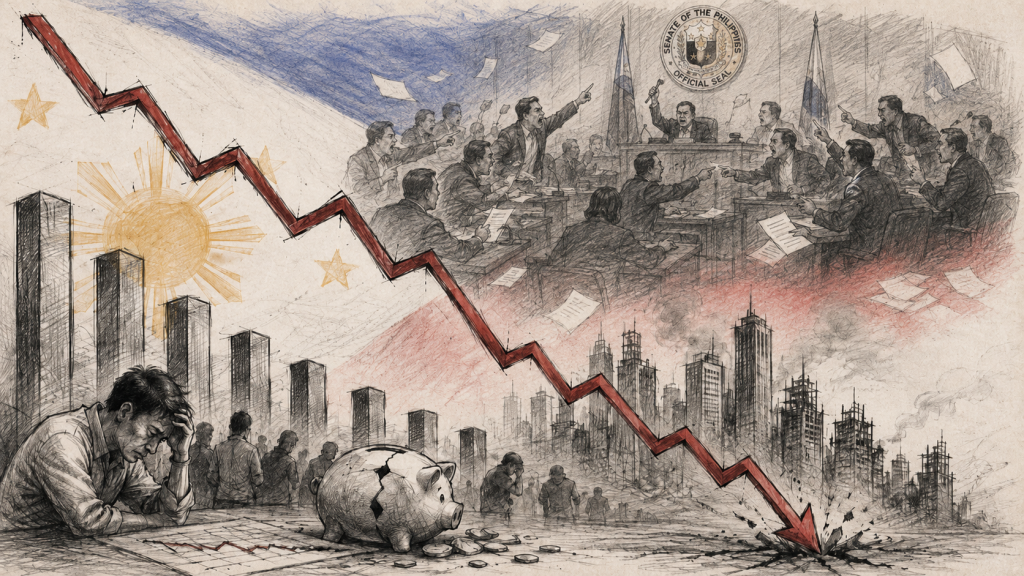
There are now signs that should make us pause. The Philippine economy appears to be losing steam and momentum. The latest real GDP growth of only 2.8% in the first quarter of 2026 is disappointing, especially for a country that needs stronger and sustained growth to create jobs, raise incomes, attract investments, and lift more Filipinos out of poverty. The Philippine Statistics Authority reported that GDP grew by only 2.8% year-on-year in the first quarter of 2026 which is beyond alarming. For many, GDP sounds like a technical number, but GDP is not an economist’s statistic. It is one of the measures that tells us whether the economy is expanding strongly enough to support businesses, employment, household income, government revenues, and long-term development. When growth slows sharply, it eventually reaches ordinary people. It shows up in fewer business expansions, weaker hiring, slower income growth, tighter budgets, lower consumer confidence, and a more difficult environment for entrepreneurs and workers.
What makes this more concerning is that the weakness appears to be broad-based. Agriculture remains under pressure because of declining production, structural inefficiencies, climate disruptions, and long-standing problems that have never been properly solved. This matters because agriculture is not just another sector, it is tied directly to food supply, food prices, rural employment, and national security. When agriculture is weak, the poor are hit twice. Farmers struggle to earn, and consumers struggle to buy. Manufacturing is also barely expanding. This should concern us because manufacturing is one of the sectors that can create stable jobs, deepen our industrial base, and help the country move beyond a consumption-driven economy. A weak manufacturing sector means we remain too dependent on imports, remittances, services, and consumption. Construction has also slowed sharply and this is significant because construction has a multiplier effect. When construction slows, it affects contractors, suppliers, laborers, engineers, architects, hardware stores, logistics firms, real estate activity, and many others connected to the value chain. Even the services sector, which has long been our economy’s growth anchor, is showing signs of moderation. This is a major concern because our economy has relied heavily on services to carry growth. When services slow, the pressure becomes even heavier on the rest of the economy.
On top of slowing growth is the big and deep concern of elevated inflation. Consumer prices continue to erode the purchasing power of ordinary Filipinos. For many families, the issue is no longer just about economic statistics. It is about the price of rice, fuel, electricity, transportation, rent, tuition, medicine, and basic needs. Even if wages increase, many households still feel poorer because prices are moving faster than their ability to cope. This is why many Filipinos say, “Kumikita naman kami, pero parang kulang pa rin.” The income may be there, but the purchasing power is being weakened.
The BSP itself has projected inflation at 3.6% in 2026 and 3.2% in 2027 in its February 2026 Monetary Policy Report, with the upward revision reflecting supply-side factors such as higher global oil and non-oil prices, higher rice tariffs, and electricity rate adjustments. There are also reports warning that inflation may breach the upper end of the target range in both 2026 and 2027. Many economists feel that actual inflation wlll be much higher than BSP’s forecasts. The inflation in April 2026 shot up to 7.2%, and the consensus is it will remain high in the coming months.
This is why the word “stagflation” is now entering the discussion. Stagflation happens when growth slows while inflation remains high. It is one of the most painful economic combinations because people are squeezed from both sides. Income opportunities weaken, while the cost of living continues to rise. That is the painful squeeze on the Filipino family. There is also a valid concern about possible supply crunch as early as June or July, especially if energy, food, logistics, and weather-related risks intensify. Any disruption in supply will not remain an economic headline. It will be felt in markets, transport terminals, factories, offices, churches, sari-sari stores, and homes.
Then we add the external risks. The geopolitical tensions involving the United States, Israel, Iran, the Strait of Hormuz, and the wider uncertainty in global oil and trade flows should not be ignored. The Philippines is vulnerable to global oil shocks because higher oil prices eventually affect transportation, electricity, food distribution, production costs, and almost everything else. Recent reports have already pointed to the impact of Middle East tensions and oil supply risks on Asian currencies and inflation pressures, especially for energy-dependent economies like the Philippines.
On the local front, we also need to watch possible weather disruptions, including El Niño-related effects, transport fare pressures, wage pressures, food supply issues, and the sustained weakening of the peso. A weaker peso makes imported goods more expensive, and because we import many essentials, this can feed into inflation.
This is the dangerous combination before us: slowing growth, elevated inflation, supply risks, geopolitical uncertainty, weak confidence, and political noise.
The recent actions in the Senate may not have created these economic vulnerabilities, but they surely did not help. They may have even accelerated them by adding another layer of uncertainty into an already fragile environment. Political institutions are not isolated from economic outcomes. When uncertainty rises, confidence weakens. When confidence weakens, investments slow down. When investments slow down, jobs, businesses, livelihoods, and household finances are affected.
This is why the Senate, and every branch of government, must consider the effect of their actions and inactions. Leadership is not theater, governance is not performance, public office is stewardship. Our leaders must understand that every careless decision, every display of arrogance, every failure of accountability, and every act that weakens public trust has economic consequences.
Markets watch, investors watch., businesses watch, ordinary Filipinos watch. And more importantly, God sees.
As a nation, we need to call out our leaders and remind them that they are accountable. Accountability is not rebellion, accountability is part of good governance. Justice is not optional, truth is not negotiable. Public trust must not be treated lightly.
But we must also do our part. We pray for the nation, we pray for our leaders, we pray for wisdom, righteousness, justice, humility, and courage. We pray not only for economic recovery, but for moral clarity. We do our work faithfully, we build our businesses responsibly, we help our families prepare wisely, we steward our resources carefully, we live within our means, we avoid reckless debt, we build emergency funds, we support local businesses, we serve others generously. And…we refuse to give in to panic, cynicism, or hopelessness.
This is also a time for families to be more intentional with money. Review your spending, strengthen your cash flow, avoid unnecessary borrowing, prepare for price increases, build buffers where you can. Do not be driven by fear, but do not be careless either.
This is a time for business owners to lead with wisdom: Manage costs carefully, protect jobs where possible, innovate, serve customers better, create value, treat people fairly. In difficult times, business is not merely about profit, it is also about stewardship, service, and resilience.
This is a time for the church to be faithful. The local church must continue to proclaim the gospel, pray for the nation, disciple people faithfully, care for the vulnerable, and equip believers to live as salt and light in every sphere of society. We cannot reduce our faith to Sunday worship while ignoring Monday realities. The gospel shapes how we work, lead, vote, spend, save, invest, give, serve, and respond to national crises.
But more than anything, I believe there must be a deliberate move for our nation to humble ourselves before the Lord, we need to intercede, we need to repent, we need to return to what is right. We need to be reminded of kingdom principles: righteousness, justice, stewardship, generosity, truth, compassion, and care for the vulnerable.
The economy matters, but the heart of the nation matters even more. Because behind weak institutions is a heart problem. Behind corruption is a heart problem. Behind greed is a heart problem. Behind injustice is a heart problem. Behind indifference to the poor is a heart problem.
This is not the time for fear, but neither is it the time for denial. This is not the time to merely complain… this is the time to pray, speak truth, work faithfully, serve generously, and act responsibly. This is a call for the nation to turn to the Lord in humility and to be proactive in whatever He has called us to do.
May the Lord have mercy on the Philippines, may He give wisdom to our leaders, may He strengthen our people, may He protect the vulnerable. May He expose what must be exposed, correct what must be corrected, and heal what must be healed.
And may He teach us once again that our ultimate hope is not in politics, markets, institutions, or money, but in Him alone.