Side Hustles, Stewardship, and the Struggles of the Gen Z
By Randell Tiongson on July 11th, 2025
Despite being more financially aware and starting to save earlier than previous generations, many Filipino Gen Zs doubt if they can ever retire comfortably. The rising cost of living, unstable income sources, and a culture of instant gratification are making it harder for this generation to plan long term.
For many, the idea of retiring at 60 — or even 65 — seems unrealistic. That’s why side hustles have become part of the new normal. They’re no longer just “extra income” — they’re essential to survive and, hopefully, to thrive.
Key Takeaways:
Many Gen Z Filipinos believe they’ll need to keep working, even past retirement age.
A growing number have side hustles — and plan to keep them long-term.
The uncertainty of the future drives many to hustle harder, but what they need most is financial stewardship.
Who Is Gen Z in the Philippines?
Generation Z includes those born between 1997 and 2012 — today’s teens and young adults, aged 13 to 28. They’re the most digital-savvy generation in history. They grew up with the internet, social media, and e-wallets.
Many of them are:
Freelancers
Online sellers
Creators and influencers
Working students or first-time earners
They are eager to learn and grow, but also carrying anxiety about their financial future — often juggling multiple responsibilities and unsure how to plan for the long term.
Why Side Hustles Matter
Let’s be honest: for most Gen Zs, isang trabaho hindi sapat. Side hustles help:
Pay tuition or bills
Support their family
Fund small pleasures (coffee, gadgets, travel)
Start savings or invest (if possible)
Some popular side hustles in the Philippines include:
Online selling (Shopee, TikTok, IG)
Freelance work (graphic design, writing, video editing)
Content creation
Tutoring
Food and courier deliveries
Direct selling and affiliate marketing
While side hustles may provide temporary relief, the bigger question remains:
Are we just hustling, or are we stewarding wisely?
From Hustling to Stewarding
Earning more is helpful — but if you don’t manage it well, it won’t go far. True financial breakthrough isn’t just about income. It’s about faithful stewardship.
Luke 16:10 – “Whoever is faithful with little will be faithful with much.”
Biblical stewardship reminds us that money is not ours — it’s entrusted to us by God. We are called to manage it:
With wisdom
With purpose
With discipline
With generosity
Practical Steps for Filipino Gen Zs
1. Track Your Spending
Use simple tools — a notebook, a spreadsheet, or budgeting apps.
“You can’t steward what you don’t monitor.”
2. Live Below Your Means
Learn to say no to lifestyle pressures. Proverbs 21:20 – “The wise store up choice food and olive oil, but fools gulp theirs down.”
3. Save Consistently, No Matter How Small
Start with whatever you can. The goal is habit, not amount.
4. Avoid Bad Debt
Credit cards and BNPL (Buy Now, Pay Later) may look attractive, but they can trap you if you’re not disciplined.
5. Plan for the Long-Term
Don’t just save for the next iPhone — save for your future family, business, or retirement.
6. Honor God Through Giving
Even with little, you can tithe and give — it forms your heart and builds trust in God’s provision. 2 Corinthians 9:7 – “God loves a cheerful giver.”
Stewardship Over Survival
Dear Gen Z, I admire your hustle. You’re resourceful, talented, and resilient. But I want to challenge you — don’t just work hard. Be wise.
Hustling may help you survive today. But stewardship will help you build a better tomorrow.
Your future is not just shaped by how much you earn. It’s shaped by how faithfully you handle what you have — big or small. Time is on your side. Use it well.
Surround yourself with mentors. Read the Bible and get connected to a church community. Learn financial principles. And remember:
You are not alone — God is your Provider. Your role is to be a faithful steward.
The Marketplace Is Not Just a Ministry — It’s a Mission Field
By Randell Tiongson on June 29th, 2025
This is something I’ve wrestled with, prayed about, and lived out for some time now.
As someone who has worked both in the corporate world and in church circles, I’ve seen the gap: many believers in the marketplace feel like they’re on the outside of the real work of ministry.
They show up on Sundays, serve when they can, tithe faithfully—but then return to the “secular world” where faith often feels muted, isolated, or irrelevant.
Let me say this plainly:
The marketplace is not just a place where you can do ministry. It is your mission field.
It is holy ground.
It is part of God’s plan for the renewal of all things.
The Marketplace and the Mission of God
From the beginning, work was part of God’s design:
“And God blessed them. And God said to them, ‘Be fruitful and multiply and fill the earth and subdue it, and have dominion over the fish of the sea and over the birds of the heavens and over every living thing that moves on the earth.’” — Genesis 1:28, ESV
Work was sacred even before there was sin. And after the fall, God’s mission became not just to save souls, but to restore all of creation—including work, business, economics, and leadership.
“And through him to reconcile to himself all things, whether on earth or in heaven, making peace by the blood of his cross.” — Colossians 1:20, ESV
Your office, your business, your projects—they’re not outside God’s plan. They’re part of it.
Kingdom Economics: Purpose Over Profit
Kingdom Economics reframes how we think about success and wealth. In the world’s system, we chase profit, prestige, and platform. But in God’s economy, the purpose of wealth is stewardship, multiplication, and mission.
“You shall remember the LORD your God, for it is he who gives you power to get wealth, that he may confirm his covenant that he swore to your fathers, as it is this day.” — Deuteronomy 8:18, ESV
Wealth, influence, and opportunity are not ends. They are means to fulfill God’s covenant purpose on the earth.
You Are Sent: A Theology of Calling
“Jesus said to them again, ‘Peace be with you. As the Father has sent me, even so I am sending you.’” — John 20:21, ESV
Too many Christians compartmentalize their lives: spiritual on Sunday, secular the rest of the week.
But in the Kingdom, there’s no divide.
Your calling is not less sacred because it happens in a boardroom, a bank, or a barangay.
God sends some to pulpits—but He sends many to the marketplace.
You are not just called to work. You are called to witness, build, restore, and reflect Christ right where you are.
N.T. Wright and the Gospel for the Marketplace
I’ve been learning much from theologian N.T. Wright lately. In his work on the Kingdom of God, he emphasizes that the resurrection of Jesus launched new creation right in the middle of the old one. God is not just saving souls for heaven—He is renewing all things through Jesus Christ.
That includes your business. Your office. Your client meetings. Your product launches.
You are not just there to succeed.
You are there to serve, rebuild, influence, and reflect Christ in a broken system.
“God intends to put the whole world right in the end. That’s the message of the gospel.” — N.T. Wright
The marketplace isn’t neutral ground—it’s contested space. And we are called to be salt and light in it.
Four Kingdom Commitments for Marketplace Believers
1. Work With Integrity
“Better is a little with righteousness than great revenues with injustice.” — Proverbs 16:8, ESV
Be honest, even when it costs. Your witness is your credibility.
2. Steward What You Have
“Moreover, it is required of stewards that they be found faithful.” — 1 Corinthians 4:2, ESV
Manage money, influence, and opportunity as one entrusted—not entitled.
3. Pursue Purpose, Not Just Platform
“But seek first the kingdom of God and his righteousness, and all these things will be added to you.” — Matthew 6:33, ESV
Don’t chase fame. Chase fruit that lasts.
4. Love People in Your Path
“In the same way, let your light shine before others, so that they may see your good works and give glory to your Father who is in heaven.” — Matthew 5:16, ESV
People around you are watching. Be present. Be kind. Be bold in love.
A Personal Appeal to Believers in the Marketplace
To my fellow believers in business, finance, education, tech, media, healthcare, and beyond—
I see you. I understand the tension you carry.
You want to be excellent, but not worldly.
You want to be influential, but not proud.
You want to serve God, but sometimes you feel like your work doesn’t count.
It does.
Your calling is real.
Your mission field is where you clock in.
Your witness is just as vital as any sermon on Sunday.
Don’t underestimate how God can use your spreadsheets, strategy sessions, leadership, and creativity to build something eternal.
A Word to the Church: Empower the Saints in the City
As church leaders and disciplers, we must equip believers not just for church roles, but for cultural roles.
Let’s teach theology of work and economics.
Let’s affirm entrepreneurs, professionals, freelancers, and government workers as missionaries.
Let’s preach about calling beyond the pulpit.
Let’s commission believers into the world—just as we do for those in “full-time” ministry.
Because the church’s job is:
“to equip the saints for the work of ministry, for building up the body of Christ.” — Ephesians 4:12, ESV
That includes ministry in the marketplace.
Where You Are is Where You’re Sent
The Kingdom of God is not only coming to church—it’s coming to your building, your Zoom call, your client meeting, and your pitch deck.
So stand tall in your calling. Work with excellence. Lead with humility. Love with intention. And let your work be worship.
Because the marketplace is not just a place for ministry. It is the mission field.
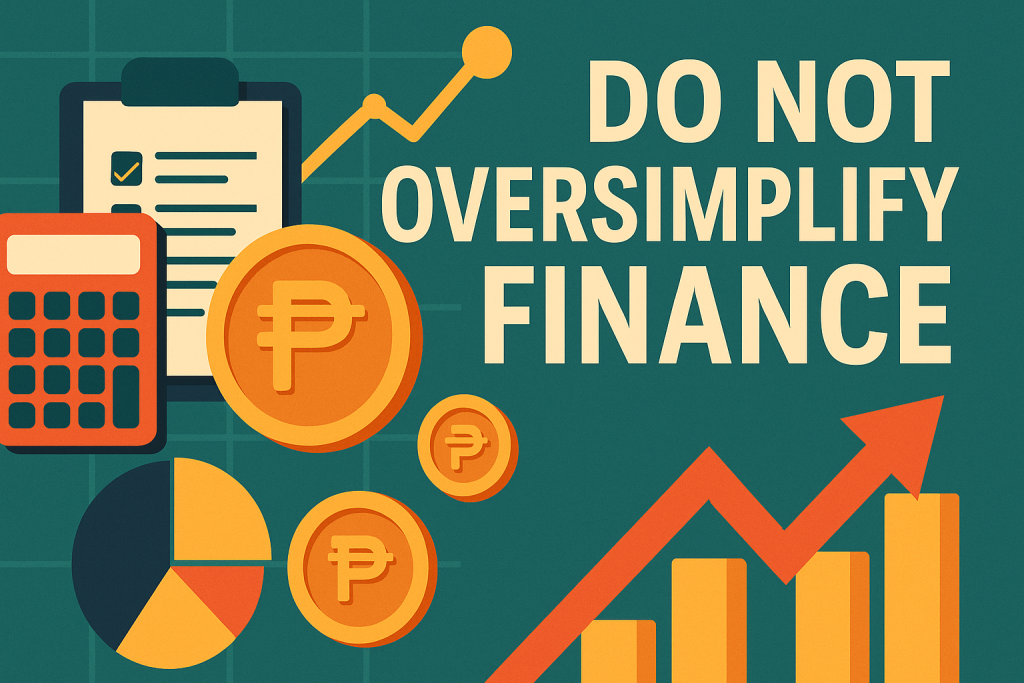
Why Oversimplifying Personal Finance Is a Bad Idea
By Randell Tiongson on June 23rd, 2025
In today’s social media-driven world, financial advice often gets reduced to catchy one-liners: “Just invest.” “Just buy insurance.” “Just stop spending on coffee.” “Just follow this budgeting app.”
It sounds good, but here’s the problem: Oversimplifying personal finance is not just unhelpful—it can be harmful.
Over the years, I’ve taught countless seminars, walked with families through financial crises, mentored OFWs, and equipped young professionals. If there’s one thing I’ve learned, it’s this:
Personal finance is not about shortcuts. It’s about stewardship.
Personal Finance is a Process, Not a One-Liner
That’s why I created my No Nonsense Personal Finance framework—not to make things complicated, but to make them intentional.
Here’s the step-by-step structure I teach:
Understand your cash flow
Manage your debt wisely
Build your emergency fund
Get insurance
Invest for your future
Plan your estate (a newly added sixth step in my 2025 edition)
Each step serves a distinct purpose. Skipping ahead may feel efficient, but in reality, it exposes gaps that can cause major setbacks. For instance, you can’t invest wisely if you’re buried in unmanageable debt or don’t have an emergency fund.
Personal finance isn’t about getting rich quick. It’s about building strong foundations and being faithful with what we’ve been given. Remember, we build wealth one peso at a time.
Most Financial Mistakes Are Behavioral, Not Mathematical
Let’s be honest—most money problems aren’t due to a lack of technical knowledge. They’re rooted in behavior.
We procrastinate. We give in to lifestyle pressure. We panic during market dips. We chase trends instead of pursuing truth.
This is where behavioral finance plays a huge role. The way we think about money—our emotions, biases, and habits—shapes our outcomes far more than formulas or tools.
“The plans of the diligent lead surely to abundance, but everyone who is hasty comes only to poverty.” — Proverbs 21:5 (ESV)
It takes discipline and wisdom to stay the course. And oversimplified advice doesn’t shape behavior—it only masks deeper issues.
Understanding Financial Instruments Matter
Here’s another risk of oversimplification: people invest in what they don’t fully understand.
I’ve seen too many Filipinos buy products they barely grasp—from variable life policies to high-risk stocks, NFTs, or “guaranteed” crypto yields. Oversimplified marketing leads to underinformed decisions.
Understanding how financial instruments, markets, and economics work is essential to long-term success and protection. We don’t need everyone to become economists—but we do need financial literacy rooted in reality, not hype.
Personal Finance is a Form of Stewardship
For me, personal finance isn’t just a technical discipline—it’s a spiritual one.
As stewards, we are not owners. We manage what has been entrusted to us.
“Moreover, it is required of stewards that they be found faithful.” — 1 Corinthians 4:2 (ESV)
That means:
Being diligent in the small things
Avoiding get-rich-quick thinking
Planning wisely, living humbly
Using our resources to bless others and advance good
Oversimplification short-circuits stewardship. It makes us passive instead of purposeful.
My Thoughts
We don’t need more viral advice. We need more faithful action. We need more wise, long-term thinking. We need more disciplined stewardship.
If you want to take control of your financial life, don’t settle for gimmicks. Embrace the process. Learn. Ask questions. Walk step-by-step.
Because your financial life is too important to leave to chance—or trends.
Let’s do it the no-nonsense way. Let’s do it the wise way.
Want to learn how to manage your finances better?
Register now and get a free copy of my e-book. Start your financial planning journey today!