Most of us spend the bulk of our adult lives working—yet many have never stopped to ask, “What is God’s purpose for my work?” For too long, we’ve separated the sacred from the secular, as if our jobs are merely earthly obligations while only ministry or missions belong to heaven’s work. But that’s not how God sees it.
Theologian N.T. Wright teaches that God’s Kingdom didn’t begin with a someday-in-heaven promise—it began with Jesus and continues through the Spirit-empowered work of His people today. And that includes your work. Every spreadsheet, business transaction, service rendered, and problem solved has potential to echo the values of the Kingdom—justice, generosity, creativity, restoration, and love.
Work is not just about income; it’s about participation in God’s redemptive plan. In fact, when God created humanity, He gave us the mandate to steward creation—not dominate it, but nurture and develop it. That mandate hasn’t changed. Your work is a continuation of Eden’s call and a reflection of the New Creation to come.
We see a striking example in 2 Kings 4:1–7. A widow, desperate and broken, comes to the prophet Elisha. She had lost her husband, and now risked losing her sons to slavery due to debt. It was a moment of despair—but God met her not with mere provision, but with a calling. Through Elisha, God asked her, “What do you have?” She replied, “A little oil.”
That “little oil” became the basis of a Kingdom enterprise. She collected jars, poured out her faith, and in the process, God multiplied her effort. She paid her debts, saved her sons, and lived on the surplus. That is God’s economy in action—where work is not divorced from faith, and business is not separate from calling. It’s a picture of God restoring lives through faithful work.
Here’s the principle:
God can use what’s in your hands.
Your work can reflect the justice and mercy of the Kingdom.
The marketplace is a field for mission.
Business done with integrity and faith is Kingdom work.
Let’s stop thinking of work as a grind and start seeing it as Kingdom participation. Let us remember that we’re not just saved from something—we’re saved for something. And one of the most tangible ways we live that out is through our work.
God is not just preparing us for heaven—He is preparing heaven to come to earth. And when you work with skill, humility, excellence, and generosity, you become part of that future breaking into the present.
So whether you’re leading a business, freelancing, managing a team, or serving clients—do it in the name of the King, for the good of others, and the glory of God. Because when we work with Kingdom purpose, our work becomes worship—and our marketplace becomes a mission field.
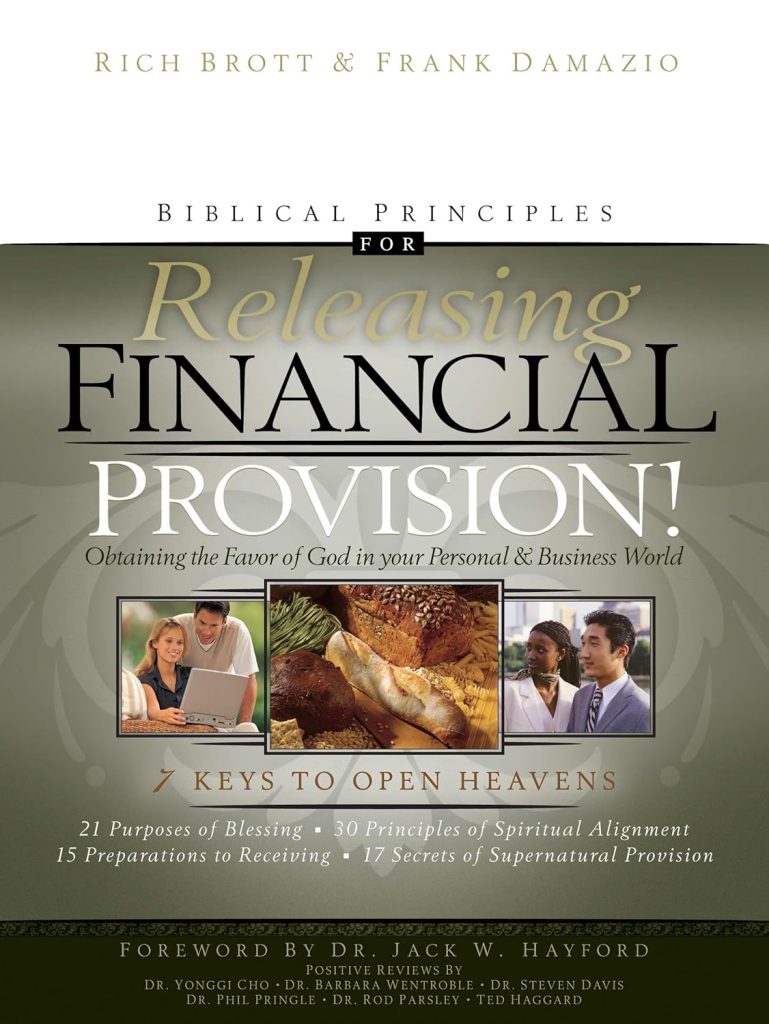
Book Summary: Releasing Financial Provision
By Randell Tiongson on June 4th, 2025
A must read book!
Early this year, received a book assignment from my Pastor and friend, Dennis Sy. I was busy with school at Every Nation Leadership Institute when he gave me the book so he told me to read it after I’m done with my studies. As soon as I graduated from the program, I grabbed the book and started reading.
I realized that while I have read many books, I hardly write and publish what I learned from the book. I am making an exception on this one because the book was very insightful and helpful to me, so here goes!
More Than Money—It’s About Mission
One of the first things I appreciated about this book is that it isn’t just about money—it’s about purpose. Damazio and Brott don’t treat provision as a goal in itself, but as a by-product of living according to God’s will. And as someone who’s spent years teaching stewardship in a Filipino context, this resonates deeply. God doesn’t just bless us for our comfort—He blesses us so we can contribute to His kingdom.
1. Understanding the Source of Provision: God as Our Provider
The book begins with a strong biblical foundation: all provision ultimately comes from God. This isn’t just theology—it’s the posture of the heart.
“Every good gift and every perfect gift is from above…” (James 1:17, ESV)
As a personal finance advocate, I see many Filipinos place their trust in jobs, sidelines, or OFW remittances. While these are channels, they are not the source. One of the most transformative lessons I’ve personally embraced—and taught—is this: God is not limited by your circumstances.
Personal Application:
In seasons when income is low or expenses are high, we need to stop asking, “Where will the money come from?” and start asking, “What is God teaching me about trust?”
2. Recognizing the Purposes of Provision
Provision is never just for survival or prosperity—it’s for stewardship. Damazio and Brott lay out purposes such as:
Providing for our needs
Enabling generosity
Advancing the gospel
Supporting our family
Demonstrating God’s faithfulness
As a Christian who teaches personal finance, I’m convicted that God’s blessings should always flow through us, not just to us. The goal isn’t to accumulate; the goal is to be a faithful conduit of God’s provision.
Personal Application:
When I teach budgeting, I now include a “generosity line” in every worksheet. It reminds us that giving is not an afterthought—it’s a design.
3. Hindrances to Financial Provision
The authors identify spiritual, emotional, and behavioral blockages that can limit provision:
Unforgiveness
Greed and selfishness
Disobedience
Fear and anxiety
Poor financial management
As Filipinos, we often see financial lack as “kalooban ng Diyos” (God’s will), but this chapter challenges that mindset. Sometimes, lack is the result of unwise choices or spiritual disconnection. There is both a spiritual and a practical side to provision.
Personal Application:
I’ve seen Christians tithing faithfully, yet drowning in debt—because they never learned to budget or say no to lifestyle inflation. Provision requires partnership with God and personal responsibility.
4. Principles of Releasing Provision
This is the heart of the book. Provision is released through faith, obedience, and stewardship. Some key principles:
Sow generously (2 Cor. 9:6–8)
Honor God with the firstfruits (Prov. 3:9–10)
Live righteously and uprightly (Psalm 84:11)
Seek the kingdom first (Matt. 6:33)
These are not formulas but faith responses. Provision isn’t earned like a salary—it’s received through alignment with God’s ways.
Personal Application:
In my own life, I’ve had moments when I obeyed God financially—like blessing someone sacrificially—and saw unexpected provision come in. God is not a vending machine, but He honors obedience rooted in faith.
5. The Role of Work, Wisdom, and Strategy
Damazio and Brott also highlight the practical channels of provision:
Diligent work (Prov. 14:23)
Wise planning (Prov. 21:5)
Faithful stewardship (Luke 16:10)
This aligns beautifully with what I’ve taught for years: Faith and finance must walk together. You cannot pray for provision while mismanaging what you already have. God multiplies what’s placed in His hands—but He still expects us to plan and work.
Personal Application:
I tell young professionals all the time—stop waiting for financial miracles if you’re wasting your salary. Stewardship is your seed; diligence is your fertilizer.
6. Declaring, Praying, and Believing for Provision
This chapter encourages boldness in prayer and proclamation. While it could lean into what some call “prosperity teaching,” the authors remain biblically grounded. It’s not about demanding from God—it’s about aligning our prayers with His promises.
Personal Application:
I now start my day with a declaration of Psalm 23:1 – “The Lord is my Shepherd; I shall not want.” Not because it’s magic, but because it sets the posture of my heart.
7. Living in the Flow of Divine Provision
Provision isn’t just about crisis moments—it’s about a lifestyle. Damazio and Brott envision Christians living in a flow of grace, where their needs are met and they are free to give, serve, and build.
Personal Application:
This is the ultimate goal of financial discipleship—not just financial peace, but financial purpose. I don’t just want to be debt-free; I want to be kingdom-free—free to go, give, and grow God’s mission.
Conclusion: Provision with Purpose
This book reinforced a key truth: God wants to provide, not just to sustain, but to empower. As someone who’s seen lives change through simple financial wisdom paired with biblical truth, I believe this message is needed now more than ever—especially in the Philippines, where poverty and abundance can exist side by side.
If you’re a pastor, provider, professional, or even just someone trying to make sense of your finances—Releasing Financial Provision! will help you think rightly, live wisely, and give freely.
The Power of Money: Neither Hero Nor Villain
By Randell Tiongson on June 1st, 2025
Money is a form of power. And like all forms of power, it can be used to serve or to harm, to heal or to destroy. It’s like fire—it can cook food or burn a house down. Money, in itself, is neutral. It only does what the one who possesses it wants it to do.
In my years of teaching personal finance and biblical stewardship, I’ve seen two common reactions to money—either people idolize it, or they demonize it. And both extremes miss the point.
Some people hate money, not because money has done anything wrong, but because they associate it with the wrongs committed by people who have it. We’ve seen corruption, greed, and exploitation—especially here in the Philippines, where abuse of wealth is a very real and painful part of our national history. So we blame money, when in fact, it is the hearts of people that are corrupt, not the pesos in their wallets.
What the Bible Really Says About Money
Let’s look at Ecclesiastes 10:19, which some versions translate as:
“A feast is made for laughter, and wine gladdens life, and money answers everything.” (ESV)
That last line—“money answers everything”—is often misused. But understanding it requires us to read it as the wisdom literature it is. The writer of Ecclesiastes (traditionally believed to be Solomon) is not making a theological declaration about money being the solution to all of life’s problems. He’s making an observational statement—a reflection on life under the sun. In practical, earthly matters, money really does answer a lot of things.
If you want to throw a party, money can pay for the food and the wine. If someone needs medicine, tuition, or shelter—money can meet those needs. That’s the context. The Hebrew word for “everything” (k?l) in this verse can also mean “all kinds of things” or “both” within a limited scope, not everything in the absolute sense. It’s not saying money is the ultimate answer—it’s saying money is a functional answer to material needs.
What It Means for Us Today
Here’s the takeaway for us: Money is not the enemy. Misplaced trust in money is.
Money doesn’t make you moral or immoral—it just amplifies who you already are. If your heart is surrendered to God, money becomes a tool for compassion, generosity, and justice. If your heart is driven by greed or fear, money becomes a weapon for manipulation, deception, or pride.
Let’s consider two examples from Scripture:
1. Money Used for Good: The Parable of the Good Samaritan
In Luke 10:25–37, Jesus tells a story about a man who was attacked and left for dead. Two religious leaders passed by and did nothing. But a Samaritan—an outsider, culturally despised—stopped, bandaged the man’s wounds, placed him on his animal, brought him to an inn, and paid for his care.
“And the next day he took out two denarii and gave them to the innkeeper, saying, ‘Take care of him, and whatever more you spend, I will repay you when I come back.’” (v. 35)
Notice: the Samaritan had compassion—but also the means to help. Money enabled him to do good. In our modern context, that could be you paying for someone’s medical bills, feeding a hungry family, or helping a student stay in school. In short: faith without works is dead—and helping others often costs money.
James puts it bluntly:
“If a brother or sister is poorly clothed and lacking in daily food, and one of you says to them, ‘Go in peace, be warmed and filled,’ without giving them the things needed for the body, what good is that?” (James 2:15–16, ESV)
For us Pinoys, we know this well. Every time a calamity hits—a typhoon, a fire, or a health crisis—our bayanihan spirit kicks in. And in those moments, money is one of the fastest ways to show mercy.
2. Money Used for Evil: The Bribery of the Guards
In Matthew 28:11–15, after Jesus rose from the dead, the guards told the chief priests what happened. The religious leaders, afraid of the truth, did this:
“And when they had assembled with the elders and taken counsel, they gave a sufficient sum of money to the soldiers and said, ‘Tell people, ‘His disciples came by night and stole him away while we were asleep.’” (vv. 12–13)
They used money to perpetuate a lie—one that tried to suppress the truth of the resurrection. That same money that could have fed the poor was used to manipulate and control.
The problem wasn’t the silver. It was the hearts of the men who gave it.
So What Does This Mean for Us, Mga Kapatid?
In the Philippines, we live in a nation where money is both a dream and a danger. We long for it—because many of us have experienced poverty. But we also fear it—because we’ve seen what it can do when abused.
So how should we view money biblically?
1. Understand Money’s Limits
Money can pay for medicine, but it can’t guarantee healing. It can build a house, but it can’t make it a home. It can fund a church building, but it can’t buy the Spirit’s presence.
Let’s stop blaming money for what it was never meant to do. And let’s stop expecting money to do what only God can.
2. Use Money as a Steward, Not an Owner
The biblical view is that we don’t own anything—we are stewards.
“The earth is the Lord’s and the fullness thereof.” (Psalm 24:1)
If we see ourselves as stewards, we’ll stop hoarding and start giving. We’ll stop being controlled by money and start controlling it for kingdom purposes.
3. Let God Form Your Heart Before He Fills Your Hands
Some of us are praying for breakthrough, promotion, or financial blessings. But if God gave us more money before shaping our character, it could destroy us. Money is a magnifier. It reveals who we really are.
So let God form your heart before He entrusts you with more in your hands.
Money is a Servant, Not a Savior
At the end of the day, money is not the villain. It’s also not the hero. It’s just a tool.
The question is: who’s holding it—and what’s in their heart?
As Christians, especially in a culture like ours where financial struggle and aspiration collide daily, let’s not blame money. Let’s redeem it.
Use it to bless. Use it to build. Use it to advance the kingdom.
But never use it to replace the God who gave it.
No one can serve two masters, for either he will hate the one and love the other, or he will be devoted to the one and despise the other. You cannot serve God and money. – Matthew 6:24, ESV
Want to learn how to manage your finances better?
Register now and get a free copy of my e-book. Start your financial planning journey today!