The Essentiality of Investing on Knowledge
By Randell Tiongson on March 14th, 2016
‘If a man empties his purse into his head no man can take it from him. An investment in knowledge pays the best interest.’ – Benjamin Franklin
This is a longer version of the usual quote “An investment in knowledge…” The author expresses a straight forward saying, which means that there will be a great outcome if you start focusing on nurturing your intellectual being. You’ll gain a better understanding over some matters, and this is not something that anyone can take away from you.
This kind of investment is something that we tapped without noticing. But add a little consciousness to it and you’ll see its essentiality.

The essentiality today
In a recent study, 60 % of the Philippine population would be people of ages 30 and below, a portion of which are the millennials. From my past blog about “Personal Finance for Millennials,” 75% of the latter spends more on experience rather than material goods. They have this hardworking, motivated, “everything in an instant” attitude, that gives them a fast pace of knowing things.
Experiences correlate with knowledge as these two are the foundation of wisdom. It is not enough if you just know it without doing it, as the same goes to if you just do it and don’t learn from it.
But, millennial or not, all of us need to keep up with the changes and learn as much as we can.
Where to find them
The technological or digital age is our period where information is within grasp. The least we can do is to make the most out of it. With the aid of a powerful tool called the internet, we know that searching for what we need now can be done easily.
Whether it is searching for a nearby library, a current event, a technological advancement, socialize to learn, etc. it’s just one click away.
It’s a great way to start on consciously investing on knowledge for its compact-ability and multiple platform-compatibility. It gives you an experience where you’ll gain knowledge at ease. This article too, is a contributor to your intellect as it gives you an insight on the essentiality of the subject matter.
But, that is just one of the sources.
One of the most effective way of consciously finding an investment opportunity in both intellect and business setting is by attending business seminars and conferences, more specifically, in the field of finance. The eminent and selfless transfer of knowledge from one body to a numerous number of persons is a great opportunity to be a part of. The people who may came from different parts of the country, yet unifies them in a single interest that gives them a sense of belongingness. Those are some things that I have observed from numerous seminars and conferences that I have been on.
The bottom-line
Our brain works in many ways, and what we need is to give input for it to make it work with ease. Knowledge is an essential investment in your intellectual well-being. It takes you to a point of view with deeper understanding of a subject.
Also, it takes out the fear of the unknown. It brightens the grey areas of your thoughts and gives you a confidence boost on what you want to endeavor, especially in business. It can be really tricky for a person who doesn’t know much how business works rather than the principle of spending money to earn money.
Being financially knowledgeable is a great way for you to know how to intelligently cope up with the ups and downs of daily business operation; Trends that you can see fit to venture in to, in order to make your money grow while spending less; And how to make your money work for you.
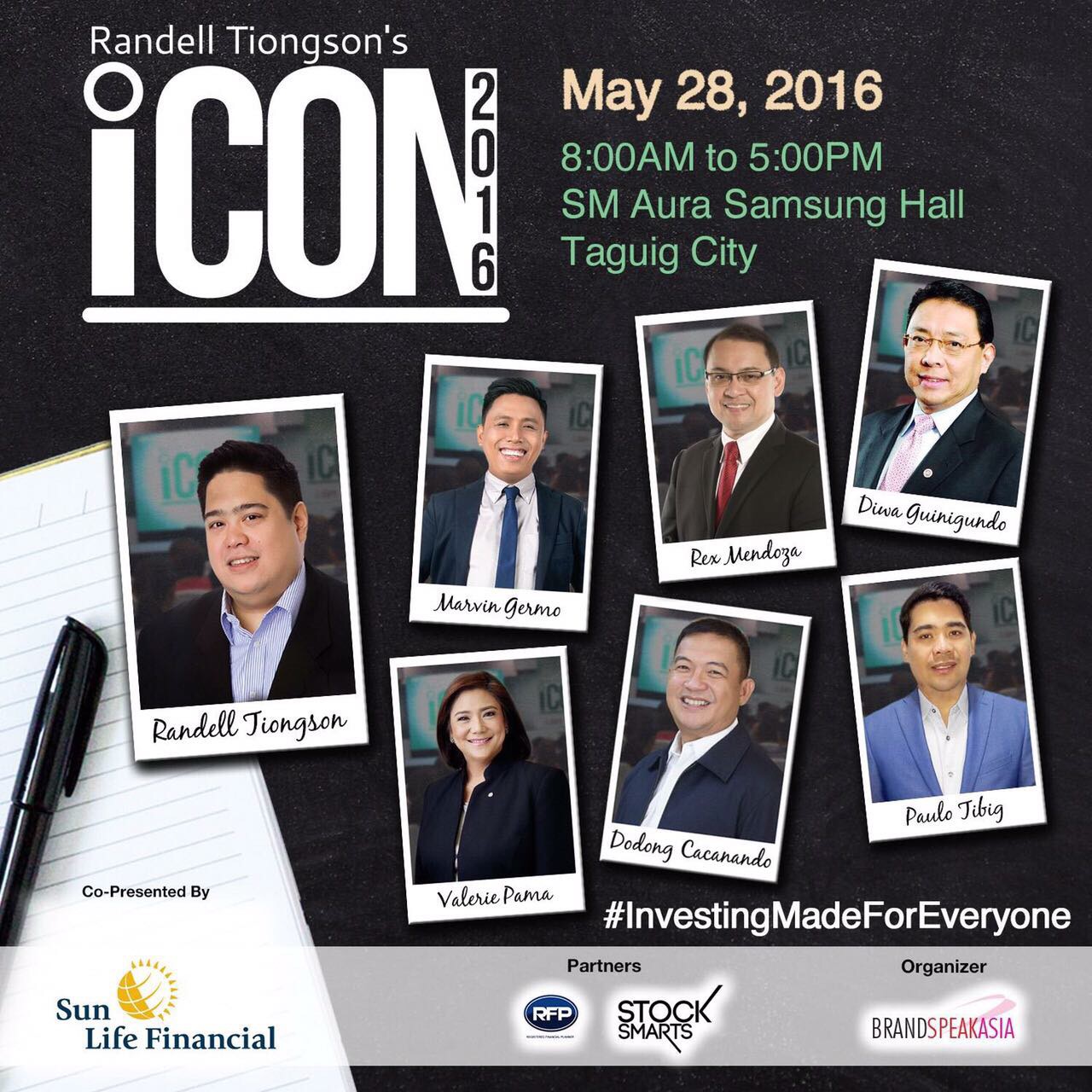
You can start investing in knowledge now by attending the fourth install of my Investment conference dubbed as #iCon 2016 this coming May 28, 2016 at the SM Aura Samsung Hall in Taguig City.
Take part of this iCON-ic event as with a bigger innovation, we have gathered a stronger group of local finance authorities in the country to talk about basic finance and how the recent innovation affected the economy through Marvin Germo, one of the most passionate personal finance experts in the Philippines; Diwa Guinigundo, an economist and Deputy Governor of the Bangko Sentral ng Pilipinas; Paulo Tibig, one of the most sought after professional speakers in the entrepreneurship community; Rex Mendoza, Founder and Managing Director of Rampver Financials and the most dynamic financial speakers in the Philippines; Jose Feron “Dodong” Cacanando, a businessman who owns Moriah Farms, Inc. and Karmel HA-Moriyah, Inc. and a truly inspiring business speaker; Valerie Pama, the President of Sun Life Asset Management, one of the country’s biggest mutual funds, and yours truly.
For transmission confirmation or questions contact Deniece Pineda at (+632) 750-6510 or 0926-691-0126 or at icon2016secretariat@gmail.com.
REGISTER NOW AT bit.ly/GO_ICON2016
Free Event: Secrets of the Rich
By Randell Tiongson on November 20th, 2015

I would like to invite you to join me as I cap the final installment of “Secrets of the Rich” series this November 25, 2015 (Wednesday) at 7:00 pm. I will be discussing sound financial principles on building wealth and will also give you practical tips on where and how you can grow your money.
This event is for FREE and it is open to all, however I suggest that you come early so that you can get good seats. The event will take place at Victory Green Hills main hall at the 4th Level of V Mall, Green Hills, San Juan City.
Thank you Victory Green Hills for organizing this life-changing events.
See you there!

Where should I invest? Mutual funds, UITF, VUL or stocks?
By Randell Tiongson on September 1st, 2015

Question: HI, I’ve recently decided to start investing, but I don’t know which product I should choose. Should I invest in variable universal life insurance, a mutual fund, UITF or buy stocks? —Asked by Josiah via Facebook
Answer: First of all, congratulations on taking this important step in your journey to financial peace! But the question of which product is right for you depends on where you are in life and what your goals are. While I can’t make any specific recommendation because I don’t know more about your financial situation, I can give you a broad overview of each product you mentioned to help you make the right decision.
I’m an advocate of life insurance, which is something Filipinos sorely lack. Variable life insurance (or VUL) is a product you can consider if you need both insurance and investment. VUL will give you insurance benefits but it will also have a fund that is being invested according to your objectives, risk profile and other preferences. If there are already people depending on your income, you should get a life insurance policy. But if your sole objective is purely investing, then this may not be the right instrument for you at this time, because in the first couple of years of your policy, most of your money will actually go toward premium payments.
If what you want is to put all your money in investments, and your risk tolerance is moderate to high, UITFs and mutual funds can work for you. A big advantage of these is that they are professionally managed by experienced investment managers, who are trained to invest properly. Even if you yourself are not well-versed in investing, you can rest assured that you’re in good hands.
The main difference between these two is that UITFs are offered by banks, while mutual funds are their own companies. By buying into a UITF, you own units of this fund. By buying into a mutual fund, you own shares and become a shareholder in the mutual fund company. All your earnings are net of tax and fees as represented by the NAVpu (net asset value per unit) for UITFs and NAVps (net asset value per share) for mutual funds.
When it comes to these pooled funds, you can choose from a variety of investments for every risk appetite. You can also choose among actively managed funds, where a fund manager tries to beat the index, or passively managed funds, which simply try to match the performance of an index.
In more economically advanced countries, passively managed funds match or outdo the performance of actively managed funds because those markets are already efficient. However, in younger markets like in the Philippines, active fund managers can still perform better than the index because the market is not efficient yet and there are still advantages they can leverage.
However, investing in mutual funds and UITFs comes with some disadvantages. The management costs can be significant, going to up to 2 percent. For UITFs, sometimes the bank branch staff aren’t trained to handle inquiries, and some of them might even discourage you.
Mutual funds and UITFs will work for you if you don’t need the money right away and can stand risk, but don’t have the time to learn all about stocks. They’re also a good vehicle for retirement funds because the long-term nature of your need will allow you to weather the fluctuations of the market. I’m encouraged by the good performance of many funds over the last few years, but keep in mind that past performance is never an indication of future performance.
Now we come to the elephant in the room: stock investing.
Individual stocks come with a lot of advantages: you have direct control over what you buy, unlike in a pooled fund that is automatically diversified. You get residual income if you buy a stock which pays out good dividends. Your returns are maximized because you’re not paying management fees, and if your individual stock outdoes the market, you make money even if the market as a whole is going down. And if you choose the right balance of stocks, your portfolio’s growth can outperform the index.
But! Before you start counting your chickens, know that stock investing is not easy to get into. You’re going to have to spend a lot of time learning about how it works. You’ll also have to learn fundamental and technical analysis, spending time reading financial reports from the companies you want to invest in and learning market trends to make the best investment choices. And to be properly diversified, you’ll need to start with a big capital; otherwise, you’ll be limited in the kind of stocks you can add to your portfolio.
Bottom line: if you want the protection of life insurance, go for a VUL. If you want to participate in the growth of the Philippine economy but don’t have the know-how to go into stocks, choose a mutual fund or a UITF.
If you have the time to learn, money to invest, and aggressiveness to match, stocks may be for you.
There are a lot of options for you if you want to start moving your money out of a savings account and into a product that can work harder for you. If you are a new investor, I recommend you invest in a pooled fund first as you learn how the stock market works and develop your competency in investing. Once you’re confident that you’ve learned enough, then you can invest in the stock market.
Whatever undertaking you choose, it must have a good foundation—this is true for investments as well. Develop your base of good money management, savvy saving, and common sense, and this solid foundation will bring you real prosperity.