Employee or entrepreneur?
By Randell Tiongson on December 12th, 2016

Question: Five years ago, I started an online business on Facebook while holding a full-time job. In the last year, my online business grew faster than in previous years, and I dedicated most of my time after work towards the business. I usually sleep way past midnight now. At the same time, my full-time job is stable and pays well.
This is my dilemma: should I be a full-time employee or a full-time entrepreneur? With the demands on my time, health, and overall well-being, I have to choose, sooner than later. Thank you po, sir Randell. —Kris via e-mail
Answer: Hi, Kris! That’s a very good dilemma to have as you’re in a stable place financially. You have the option to choose. While you’re financially stable, I understand where you are coming from. Your passion, maybe, lies in the online business.
But at the same time, you can’t disregard the security and stability full-time employment offers you.
Below is a checklist I made to help you determine whether you should be an employee or an entrepreneur:
Be an employee if:
- You don’t have a safety net, yet you have multiple responsibilities.
If your emergency fund is insufficient, you are still paying down your debts and loans, and you have a family to care for, then employment would be the better option. Entrepreneurship is very risky at the start and you can’t afford that with the responsibilities on your plate.
- You prefer working at a set time instead of being on call 24/7.
If you’re the type who stops thinking about work the moment you close your laptop, then the traditional 9-to-5 suits you better. This allows you to focus on your hobbies and passions after working hours.
- You’re prepared to experience income swings.
If earning six digits one month and then zero the next will give you a heart attack, then employment is the better choice for you. In entrepreneurship, your income will be fluctuating.
- Your workplace offers flexible working opportunities.
Some companies allow you to work from home and will even pay for the furniture for your home office. If your company is like this, then this kind of employment will give you the environment of self-employment with the stability of a full-time job.
- The income from your side business doesn’t exceed your salary.
Unless you have a large safety net, never quit your job if your business doesn’t bring in more money than your full-time job. When computing for this, also take into account how much you’ll pay for insurance costs and taxes which your employer does for you in a full-time job.
Be an entrepreneur if:
- You thrive under pressure.
Unlike a full-time job where you earn according to the number of hours you log in, in a business, you earn according to the amount of work you put in. If you thrive under pressure and are always looking at how you can improve and grow, being an entrepreneur may be your calling.
- You’re a risk-taker.
From getting potential clients to increasing your revenues, entrepreneurship is a very different environment compared to full-time employment where you do the same work and earn a set income every month. If you live the high-risk, high-reward mantra, then entrepreneurship is for you.
- You’re a ‘jack of all trades’ rather than a specialist.
When you’re an entrepreneur, you’re the marketer, the finance and sales person, the HR officer, and the business development expert all rolled into one. If you love continuous learning and self-development, being an entrepreneur is the right fit for you.
- You can be your own salesperson.
To keep your business alive, this means marketing and selling your business to potential clients. If a room full of strangers excites you, then you have the blood of an entrepreneur who can garner clients and customers with your networking savvy.
- Your revenue continues to grow and you have a loyal customer and/or client base.
If you are in this situation, then you know it’s really time to jump.
At the end of the day, this is one of the key factors. Before you jump ship and become an entrepreneur, make sure that your business is stable and continues to grow. This is your bread and butter, and you’ll need the business to still be alive decades down the road to meet your needs.
Kris, hope these checklists help. This is no easy decision. Both options (employment and entrepreneurship) have their own pros and cons. Both options can bring you success and joy. It all depends on your present condition (current finances, responsibilities, etc.), your risk tolerance, and what your inner self is telling you. I also recommend you pray about this big decision of yours — clarity always comes from the Lord.
God bless you as you determine your path!
————-
Join Francis Kong’s Power Up for Peak Performance and start your 2017 right!

For details, visit www.successoptionsinc.com
Book bundle Christmas promo!
By Randell Tiongson on December 4th, 2016
EXTENDED until Friday, December 9, 2016!!! (Bundle 1 Sold Out!)
Looking for a great Christmas gift? Why not a gift that will bring financial empowerment?
For a limited period, you can get my books with incredible discounts so you can can give awesome gifts and save money.
Bundle 1:
No Nonsense Personal Finance + Money Manifesto + Everyday Moneyfesto books at P1,000.00 only! Save P400.00 — SOLD OUT!!!

Bundle 2:
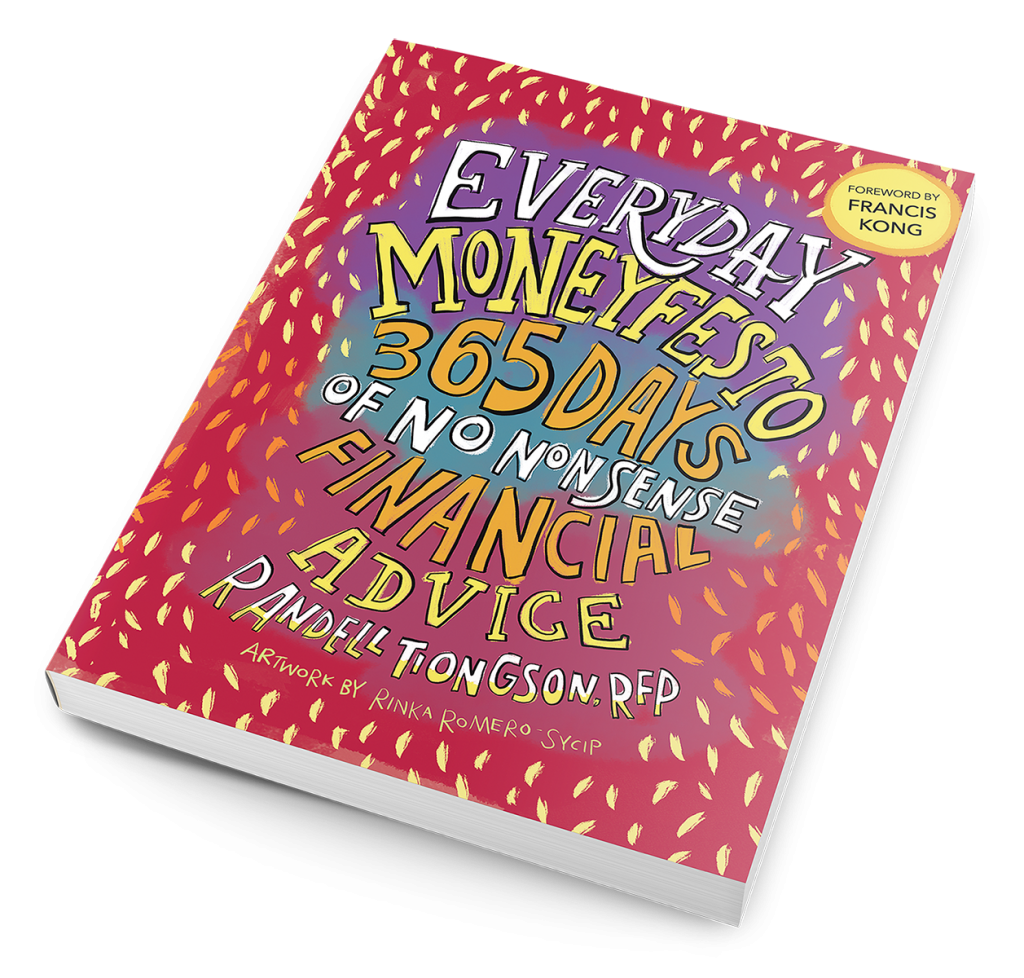
5 Everyday Moneyfesto books (new compact edition) at P1,000.00 only! Save P500.00
Bundle 3:
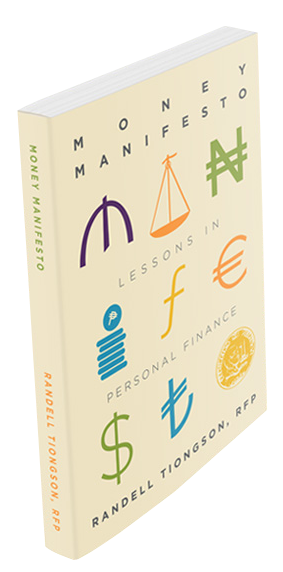
3 Money Manifesto books at P1,200.00 only! Save P600.00
This promo will end on Wednesday, December 7, 2016. Shipping is free for Metro Manila orders, for provincial orders please add P100.00
Here’s how you can order:
- Deposit of transfer the payment to BDO 006440069496 or BPI 0249111309 under John Randell Tiongson.
- Send a picture of the deposit slip or transaction advice to michael@randelltiongson.com with your complete address and contact number.
- Expect the books in a few days!
Hurry, this is a very limited offer!
Merry Christmas to all! Remember, Jesus is the reason.
10 Things to do with your 13th Month Pay
By Randell Tiongson on November 7th, 2016
QUESTION: It’s almost the end of the year, and I’m excited for my 13th month pay. I plan to use it to buy Christmas gifts for my family and friends, but I know I’m not supposed to spend all of it. What are the best ways to use the extra money?—Emily via e-mail

Answer: Ah, yes—the 13th month pay. For others, it even reaches the 15th month. That’s one to three months’ salary. There’s a lot you can do with the money, such as use it to buy Christmas presents, but I strongly suggest that you not spend it all. Aside from saving a part of the money, below are 10 things you can do with your 13th month pay:
1) Remove it from your payroll account
You probably have a question mark on your face, until you realize that inflation is eating up the value of your money. Unless you have P1 million in your account, you’re only earning 0.25 percent in interest yearly versus the 4 percent inflation rate in the Philippines last 2014. Withdraw a portion of your money from your payroll account and put it into higher-yielding accounts such as time deposits or investment accounts.
2) Plan and allot
According to research from the National Endowment for Financial Education, roughly 70 percent of people who come into windfalls end up broke within seven years. This is because they aren’t used to managing a large sum. Before you spend your 13th month pay, plan how you’re going to use it. Set a specific percentage which will go to savings, investments, and debt payments among others.
3) Increase your emergency fund
If you don’t have an emergency fund yet (roughly three to six months of living expenses), allocate a portion of your money to building one. This fund prepares you for unforeseen expenses such as emergency health costs, a sudden home repair, and even a job loss.
4) Build up your retirement fund
Your retirement fund is different from your emergency fund. Where the latter protects you from unforeseen events in the near future, your retirement fund prepares you for the more long-term future. As mentioned a while ago, remove the money from low-yielding accounts such as your savings or checking account, and put it in higher-yielding accounts such as investments.
5) Invest
There are many investments to choose from — mutual funds, unit investment trust funds (UITFs), stocks, variable universal life insurance and real estate to name a few. Your choice will depend on your risk tolerance. Whether you’re investing in mutual funds or the stock market, you’re sure to beat the 0.25 percent inflation rate of savings and checking accounts.
6) Pay off debt
Speed up your debt payment timeline and use a part of your 13th month pay to pay your debts, be it credit card debt, personal loans, car monthly payments, or what have you. Remember that the interest rates on these debts are sky high—it’s 3.5 percent a month for late credit card payments —so use the small windfall to tackle high-interest debt.
7) Important repairs
Your home may need a few repairs. For this, it’s best to resolve these sooner rather than later.
Taking preventive rather than corrective measures may save you big bucks in the future. If you put off repairing a plumbing leak, you may end up spending big bucks when your flooring or walls are affected by the leak.
8) Fund a fund
Whether it’s your travel or shoe fund, you can set a portion of your 13th month pay to fund items or experiences you’ve been saving up for.
If you love to save, you may have forgotten to treat yourself. You probably don’t remember the last time you went on a vacation or treated yourself to a nice dinner out. You deserve some relief from time to time, so set a portion to ramp up any ‘fun’ funds you have.
9) Spend on yourself
Related to the above, it’s hard to penny pinch all the time. It’s important to prepare for your future, but it shouldn’t be at the expense or to the detriment of your present self. Decades down the road, when you’re reliving your younger years to your grandchildren or to your friends during your university’s 50th-year reunion, you don’t want to stand on the sidelines without anything to say. Once you’ve made sure you’ve saved up for your future self, treat your present self to something nice. To have an easier time managing your ‘fun’ money from your savings or retirement fund, have separate accounts depending on what you’ll use the money for.
10) Bless others
Last but definitely not the least, share your blessings with others. Whether it’s donating to your local church or a cause you feel strongly about, never forget to give back. This develops the core value of sharing wealth with others in need and teaches you to appreciate the material goods you have. It’s also a reminder of stewardship and that money is really the Lord’s—we are merely managers.
There are many ways to use your 13th month pay. The bottom line is proper money management. Money is not a means to an end; it’s a vehicle for us to do what we want—whether it’s living a comfortable retirement or going on the vacation you’ve always dreamt of. When you receive your 13th month pay, don’t spend it all in one go. Budget and plan it, and if you can, share it.
“The wise have wealth and luxury, but fools spend whatever they get.” (Proverbs 21:20, NLT)