Work Is Good, But Work Is Not God
By Randell Tiongson on June 25th, 2026
I was attending a training program from Every Nation Seminary Professor and Pastor Dr. Adam Mabry on the Theology of Work, and it reminded me how much we need to recover a healthy and biblical view of work. Let me share with you the learning and insights from Dr. Mabry…
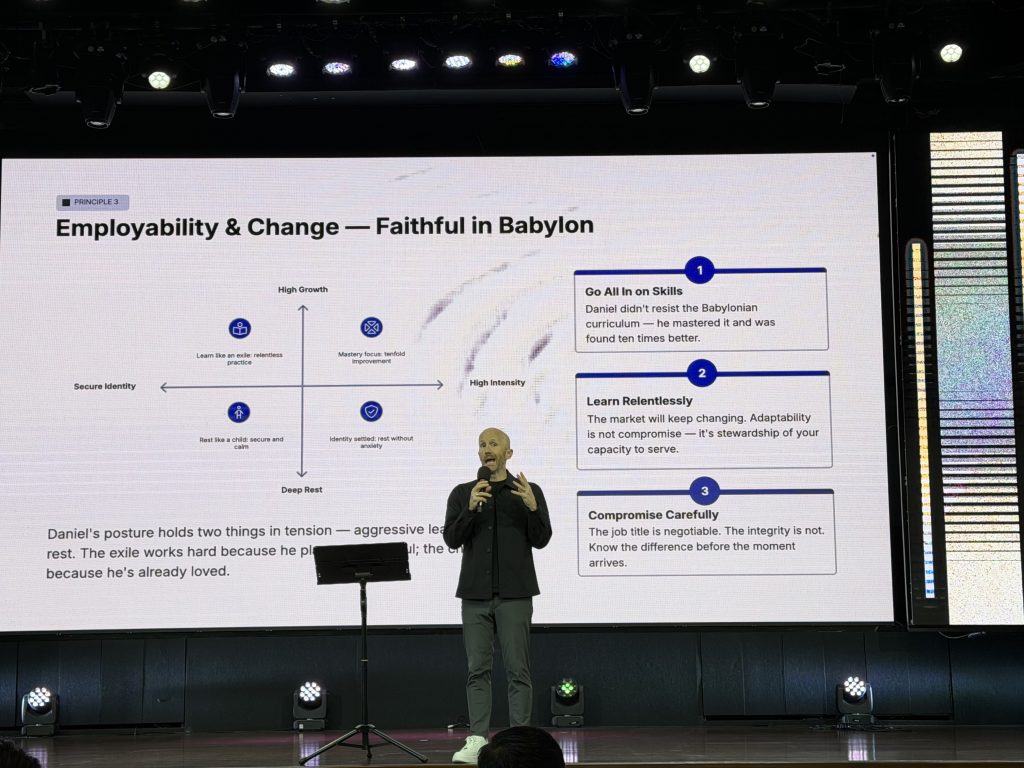
Many Christians, whether consciously or unconsciously, have embraced a false dichotomy. We often think that ministry is holy, while ordinary work is merely ordinary. We assume that the pastor, missionary, priest, preacher, or church worker is doing sacred work, while the businessperson, employee, entrepreneur, teacher, artist, banker, engineer, government worker, homemaker, or professional is simply doing secular work.
This may sound spiritual, but it is not biblical. In many ways, this way of thinking sounds more like ancient Greek philosophy than Christian theology. In some Platonic or Aristotelian streams of thought, the contemplative life was considered higher than manual labor, and ordinary work was often viewed as something beneath the truly enlightened person. In many ancient cultures, the gods rested while humans labored. Work was seen as a burden for lesser beings, not as a noble calling for image-bearers. Sadly, many of us still carry this kind of thinking today. We may not say it outright, but we often act as if the church building is sacred while the office is secular, as if Sunday worship matters to God while Monday work does not, and as if God is more interested in what happens in a worship service than what happens in a boardroom, classroom, kitchen, farm, hospital, factory, marketplace, or home. To be honest, I used to think the same many years ago.
The Bible gives us a much better story. From the very beginning, work was not a punishment. Work was part of God’s good design. Before sin entered the world, before the fall, before frustration and thorns and pain, God gave humanity work to do. Genesis 1:26–28 says, “Then God said, ‘Let us make man in our image, after our likeness. And let them have dominion over the fish of the sea, and over the birds of the heavens, and over the livestock, and over all the earth, and over every creeping thing that creeps on the earth.’ So God created man in his own image, in the image of God he created him; male and female he created them. And God blessed them. And God said to them, ‘Be fruitful and multiply and fill the earth and subdue it, and have dominion over the fish of the sea, and over the birds of the heavens, and over every living thing that moves on the earth.’”
Humanity was made in the image and likeness of God. We were created by a Maker, and because we bear His image, we were made to create, cultivate, steward, build, and bring order. To image God is not only to think, feel, and relate. To image God is also to work. We were made in the image and likeness of a working God. Genesis 2:15 says, “The LORD God took the man and put him in the garden of Eden to work it and keep it.”
The Hebrew words often associated with this are abad, which means to work or serve, and shamar, which means to keep, guard, or watch over. These are not merely agricultural words. They are also priestly words. This tells us that from the beginning, human work had a sacred dimension. Adam was not merely a gardener. He was a steward. He was not merely maintaining property. He was serving before God.
This means work is not beneath us, work is part of our calling. We were made for labor, not laziness. We were made to cultivate, not merely consume. We were made to steward, not merely accumulate. We were made to contribute to God’s world, not merely extract from it.
Timothy Keller, in his book Every Good Endeavor, reminds us that work is one of the ways we reflect God’s character and serve His creation. Our work matters because God Himself works, and God uses human work as one of His means to care for the world. Through work, food is grown, families are provided for, homes are built, children are taught, the sick are treated, businesses are formed, communities are served, justice is pursued, beauty is created, and needs are met.
The problem is not work, the problem is what sin has done to work. Genesis 3:17–19 says, “And to Adam he said, ‘Because you have listened to the voice of your wife and have eaten of the tree of which I commanded you, “You shall not eat of it,” cursed is the ground because of you; in pain you shall eat of it all the days of your life; thorns and thistles it shall bring forth for you; and you shall eat the plants of the field. By the sweat of your face you shall eat bread, till you return to the ground, for out of it you were taken; for you are dust, and to dust you shall return.’”
When humanity sought autonomy from God, work became painful, frustrating, and distorted. The ground that was meant to be cultivated would now produce thorns and thistles. The work that was meant to be fruitful would now be marked by sweat, struggle, and frustration.
Sin did not create work, but sin corrupted work. Because of sin, work became distorted in many ways. Work became a place of slavery, poverty, relational brokenness, abuse, exploitation, greed, pride, and idolatry. What God designed as stewardship became a means of self-glory. What God intended as service became a platform for domination. What God gave as a gift became a way for humanity to play God.
This is why work can go wrong in at least two major ways.
First, work becomes corrupted by idolatry when we worship our work. We make our career, income, title, productivity, business, platform, or success the source of our identity, security, and significance. We begin to believe that we are only valuable when we are productive, only secure when we are earning, only important when we are noticed, and only successful when we are ahead of others.
Second, work becomes corrupted by injustice when we weaponize our work. We use our position, influence, systems, leadership, money, or authority to exploit, manipulate, oppress, or dehumanize others. Instead of using work to serve people, we use people to serve our work.
This is where we need to examine our hearts. The burnout and the slacker may appear to be opposites, but they can actually be worshiping the same false god. The idol of comfort makes us lazy, while the idol of approval makes us restless. One person refuses to work faithfully because comfort has become ultimate. Another person cannot stop working because achievement has become ultimate. Both are forms of bondage.
The lazy person may say, “I do not want to be inconvenienced.” The restless person may say, “I need to prove myself.” One is enslaved to ease, while the other is enslaved to approval. Both have forgotten that work is good, but work is not God.
The gospel frees us from both laziness and workaholism. Because of the gospel, we can say that our work is good, so we should do it well. Colossians 3:23 says, “Whatever you do, work heartily, as for the Lord and not for men.”
This means our work matters to God, even when people do not see it, appreciate it, reward it, or understand it.
At the same time, because of the gospel, we can also say that our work is not our god, so we can finally rest. We do not need to prove our worth through our productivity because our worth is already secure in Christ. We do not need to make work our savior because Jesus already is.
This is why Sabbath is so important. Sabbath is not merely the absence of work, sabbath is the boundary that gives work its proper shape. Rest reminds us that we are not machines, not slaves, and not saviors. Rest reminds us that God is God, and we are not. Rest teaches us that the world does not fall apart when we stop working, because the world is sustained by God and not by us.
A person who cannot work faithfully has misunderstood creation. A person who cannot rest peacefully has misunderstood redemption.
The biblical view of work requires rhythm. We work because God created us to cultivate. We rest because God created us to trust. Work without rest becomes slavery, but rest without work becomes irresponsibility. God calls us to both diligence and dependence.
This is also why stewardship matters. In the parable of the talents, Jesus shows us that what has been entrusted to us must be used faithfully. Our abilities, opportunities, resources, networks, experiences, and influence are not ultimately ours. They are entrusted to us by God, and we are called to steward them for His purposes. Stewardship changes the way we see work. We are not owners who use everything for ourselves. We are stewards who manage what belongs to God. This means our businesses, careers, professions, platforms, and resources should be used in ways that honor Him and bless others.
This is especially important for us today.
Many of us were raised to see work mainly as survival. We work to pay bills, send children to school, support extended family, help relatives, and prepare for the future. For many OFWs, work means sacrifice. For many employees, work means endurance. For many entrepreneurs, work means pressure. For many professionals, work means performance. For many leaders, work means responsibility.
There is nothing wrong with providing for our families. In fact, providing is part of faithful stewardship. Yet the Bible gives us a vision of work that is bigger than survival and bigger than success.
We do not work merely to accumulate, we work so we can contribute. We do not work merely to upgrade our lifestyle. we work so we can become a blessing. We do not work merely to build our name, we work for the glory of the One who called us.
Ephesians 4:28 says, “Let the thief no longer steal, but rather let him labor, doing honest work with his own hands, so that he may have something to share with anyone in need.” That is a radical view of work. The goal is not merely to stop stealing, the goal is to become generous. You do not work only so you can have more, you work so you can give more.
This is where work becomes worshipful and others-oriented. Work becomes worshipful when it is done unto the Lord. Work becomes others-oriented when it seeks to serve, bless, build, protect, provide, and contribute. Work becomes idolatrous when it becomes all about our identity, our comfort, our approval, our wealth, our power, or our control.
Jesus Himself said in John 5:17, “But Jesus answered them, ‘My Father is working until now, and I am working.’” God is still at work in His world, and He calls His people into redemptive work. This means that our work can become part of God’s redemptive purposes when it is submitted to Him. A teacher participates in redemptive work when students are formed in wisdom and truth. A businessperson participates in redemptive work when value is created, people are treated with dignity, and resources are stewarded well. A government worker participates in redemptive work when justice and public good are pursued. A parent participates in redemptive work when children are nurtured in love and faith. A financial professional participates in redemptive work when people are taught stewardship instead of greed. A pastor participates in redemptive work when people are equipped to follow Christ in every sphere of life.
Ministry is holy, but ministry is not the only holy work. Ordinary work offered to God becomes worship. Ordinary work done in faithfulness becomes service. Ordinary work submitted to Christ becomes a witness.

This is why we must also understand calling properly. Our primary calling is to belong to Christ. This calling is permanent, secure, and unconditional. Before we are called to a job, business, profession, platform, or assignment, we are first called to Jesus. Our deepest identity is not employee, entrepreneur, pastor, speaker, parent, leader, or professional. Our deepest identity is that we belong to Christ. Our secondary calling is the specific work God has entrusted to us in this season. This work is real and meaningful, but it is not ultimate. Jobs may change, businesses may rise or fall, careers may shift, titles may disappear, and platforms may fade. Christ remains.
This gives us both courage and humility. We can work hard because our work matters. We can also rest well because our work is not ultimate. We can pursue excellence because we serve the Lord. We can release anxiety because we are not the Lord. We can steward influence because God entrusted it to us. We can surrender outcomes because God is sovereign over us.
Ecclesiastes 2:24 says, “There is nothing better for a person than that he should eat and drink and find enjoyment in his toil. This also, I saw, is from the hand of God.” This reminds us that work is not only responsibility, work can also be a gift to enjoy. There is a kind of joy that comes when we receive our work from God, do it before God, and offer it back to God.
The story of Scripture begins in a garden and ends in a city. It begins with creation, moves through cultivation, is redeemed in Christ, and ends in renewal. God’s plan is not to abandon creation, but to renew it. This gives meaning to our labor today.
Our work is not meaningless when it is done in Christ. Our labor can become a signpost of God’s coming kingdom. Our workplaces can become places of worship, service, justice, generosity, creativity, and witness.
A healthy view of work teaches us that work is good, but work is fallen. Work can be redeemed, but work is not ultimate. Work is a gift, but it must never become a god.
So let us work with excellence, but let us not worship excellence. Let us pursue fruitfulness, but let us not make fruitfulness our identity. Let us provide for our families, but let us not make money our master. Let us lead with diligence, but let us not use leadership to control others. Let us rest with trust, because God is still working even when we are not.
We were made in the image and likeness of a Maker, therefore, we were made to work. We were redeemed by Christ, therefore, we are free not to worship our work. We are filled with the Spirit, therefore, we can work in ways that are worshipful, faithful, generous, and others-oriented.
Ultimately, we do not work for our name. We work for the glory of the One who called us.